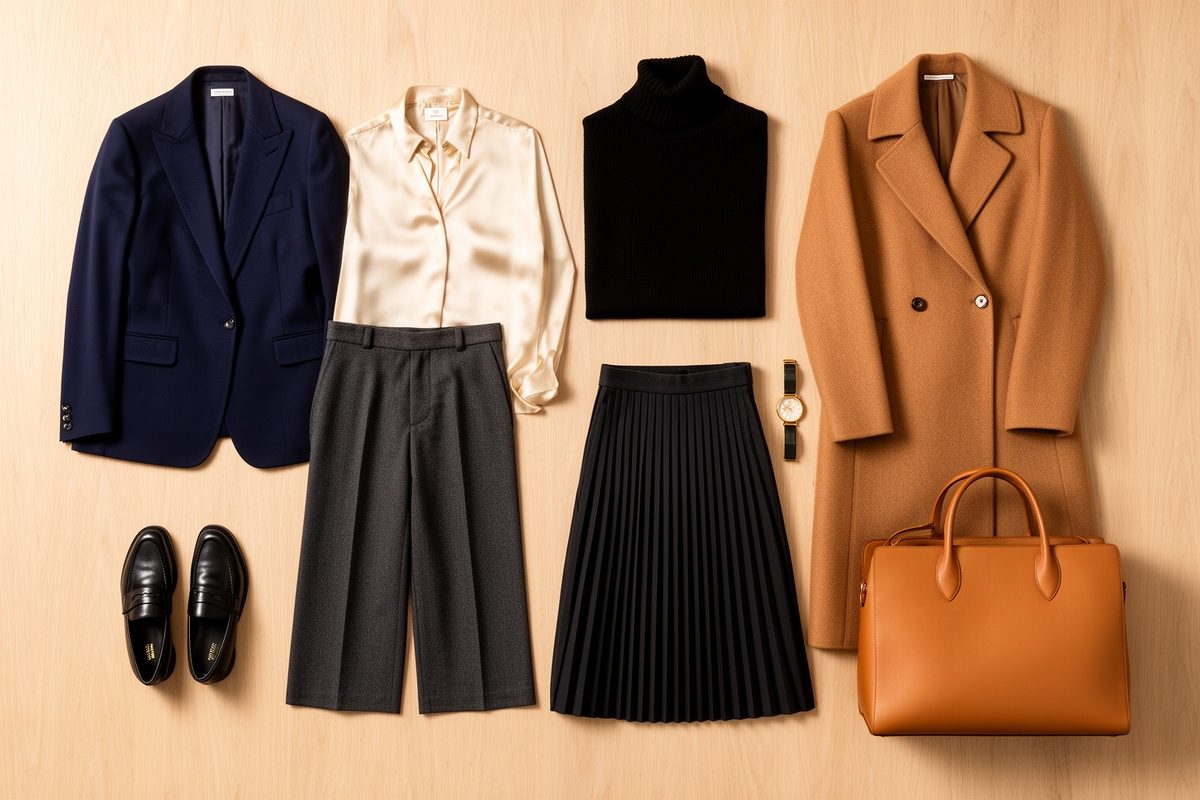
Work dressing got harder when offices got vague. There is no longer a uniform to follow, just a set of unwritten expectations that change depending on whether the day holds a desk, a presentation, a client lunch or a video call with someone two levels above you. The result is a closet full of clothes bought for specific days and nothing that works across all of them.
A workwear capsule solves it with arithmetic. Eighteen pieces, chosen so that most of them combine, cover an entire working season. Below is the list, the five formulas that do the heavy lifting, and what to buy first if you are starting from very little.
The Principle: Two Neutrals and One Color
A capsule works because of color discipline, not because of the number of items.
Pick two neutrals that go together and build almost everything in them. The strongest pairs are navy with camel, charcoal with cream, and espresso brown with ivory. Black with grey works but is the harshest against most faces.
Then allow yourself one accent color that suits your complexion: burgundy, forest, teal, rust, cobalt. Every accent piece must work with both neutrals, which is the only rule that matters. If you do not know which colors sit well on you, the skin tone color guide is the place to start, because a capsule in the wrong colors is eighteen pieces you never wear.
The Eighteen Pieces
Tailoring: 4 pieces
- A blazer in your main neutral. The most valuable item in the entire capsule. It converts any outfit into a work outfit. Single breasted, structured enough to hold a shoulder, long enough to cover the hip.
- A second blazer, softer. Unstructured, in a knit or a flannel, in your second neutral. For days where the first blazer is too much.
- Wide-leg tailored trousers in your main neutral, hemmed to just off the floor.
- A straight or slim trouser in your second neutral, for boots and flats.
Tops: 6 pieces
- A silk or satin blouse in cream or ivory. Under a blazer it is a client meeting, alone it is a Thursday.
- A second blouse in your accent color.
- A fine-knit turtleneck in black, charcoal or espresso. The most useful work piece after the blazer, because it works under everything and needs no ironing.
- A crewneck fine knit in cream or camel.
- A crisp cotton shirt in white or pale blue.
- A sleeveless shell or fine-knit tank for layering under blazers in a warm office.
Dresses and skirts: 3 pieces
- A knee or midi-length sheath or wrap dress in a neutral. A dress is the fastest route out of the house and the easiest thing to make look deliberate with one necklace.
- A pleated midi skirt in your accent color or a neutral. Movement, which a capsule otherwise lacks.
- A knit dress in a dark neutral, for cold days and long meetings.
Denim and casual: 2 pieces
- Dark straight-leg jeans, no distressing, no fading, hemmed properly. Editors currently list frayed and cropped hems among the dated denim trends, which is doubly true at work. In most offices these now cover Friday and plenty of other days. Getting the cut right matters more than the brand, which is what the jeans fit guide is for.
- A substantial cardigan or knit jacket in a neutral, long enough to work as a layer rather than a cover-up.
Outerwear and shoes: 3 pieces
- A long wool coat in camel, espresso or navy. Everyone sees the coat, so it carries more weight than its share of the budget. This season's shapes covers what to look for.
- Leather loafers or flat boots in brown or black.
- A low heel, pointed, in a neutral. Not high. You will walk in these.
Plus the three things that are not clothes but do more than any single garment: a structured leather tote that fits a laptop, one pair of gold or silver earrings with real presence, and a slim belt in each neutral.
The Five Formulas
The point of a capsule is that you stop composing outfits and start selecting formulas. These five cover a working week.
1. Desk day. Fine-knit turtleneck plus wide-leg trousers plus loafers plus earrings. Takes four minutes and reads as competent.
2. Presentation or client meeting. Structured blazer plus silk blouse plus the straight trouser plus the low heel plus the tote. The blazer is the entire message.
3. Smart Friday. Dark straight jeans plus the cream knit plus the soft blazer plus loafers.
4. Day into evening. Knit dress or midi skirt plus accent blouse plus heels, with the blazer coming off and the earrings going up a size for a dinner afterward. The method is in the day-to-night guide, and business dinner dressing covers the rest.
5. Cold-day armor. Knit dress plus opaque tights plus flat boots plus the long coat plus a good scarf. Warm, sharp, no thinking required.
Five formulas, worn with variation, is more than a working week. Nobody notices repetition in neutral tailoring, which is the quiet secret of every well-dressed person at your office.
What to Buy First
If you are building from almost nothing, buy in this order. The first four get you dressed; the rest add range.
- The blazer in your main neutral
- The wide-leg trousers in the same neutral
- The fine-knit turtleneck
- The loafers
- The silk blouse
- The long coat
That is six pieces that produce roughly a dozen outfits, built on the same logic as a general capsule wardrobe, narrowed to the working week. Add the rest over a season rather than in one weekend, which is both cheaper and more accurate, because you will learn what your actual week demands.
Where to Spend and Where Not To
Spend on: the blazer, the coat, the trousers and the shoes. These are the structural pieces, and the difference between a cheap and a good version is visible across a conference table. A well-cut blazer in a wool blend will outlast four polyester ones and will not shine at the elbows.
Save on: knits in basic colors, the cotton shirt, the shell tops, the belts. A fine-knit turtleneck from an inexpensive brand, replaced every couple of years, is a perfectly rational purchase.
The fabric test: check the content label on anything tailored. Wool or a wool blend for blazers and trousers, cotton for shirts, cashmere or merino for knits, and avoid 100 percent polyester in anything that sits next to your skin for eight hours. Our investment pieces guide goes deeper on the economics.
Tailoring is the cheapest upgrade available. Trouser hems, blazer sleeve length, a skirt taken in at the waist. Thirty dollars of alterations on a mid-range blazer beats three hundred dollars of label.
Fitting the Capsule to Your Own Shape
The eighteen pieces are a structure, not a prescription, and three substitutions cover most bodies.
If your hips are your widest point, swap the slim trouser for a second wide leg and choose blazers that end below the widest part of the hip. If your shoulders are broad, choose a softer shoulder on both blazers and keep volume in the trousers. If you carry weight through the middle, a longer unbuttoned blazer over a vertical column of one color does more than any shapewear, and a wrap dress beats a sheath.
The one universal piece of advice: mark your waist somewhere in every outfit, with a belt, a tuck, a wrap or a seam. It is the difference between tailoring that looks sharp and tailoring that looks like a uniform, and it is why one silhouette gets an article of its own.
If you want the substitutions chosen for your actual proportions, upload a photo to the FreeDiva stylist and it will read your shape and coloring and build complete work looks from it. And when the office party lands at the end of it all, the holiday party guide shows how little you need to add: in most cases, one velvet blazer.
Want Personalized Outfit Recommendations?
Upload a photo and let our AI stylist create complete outfits tailored to your body type, skin tone, and personal style.
Try AI Stylist

