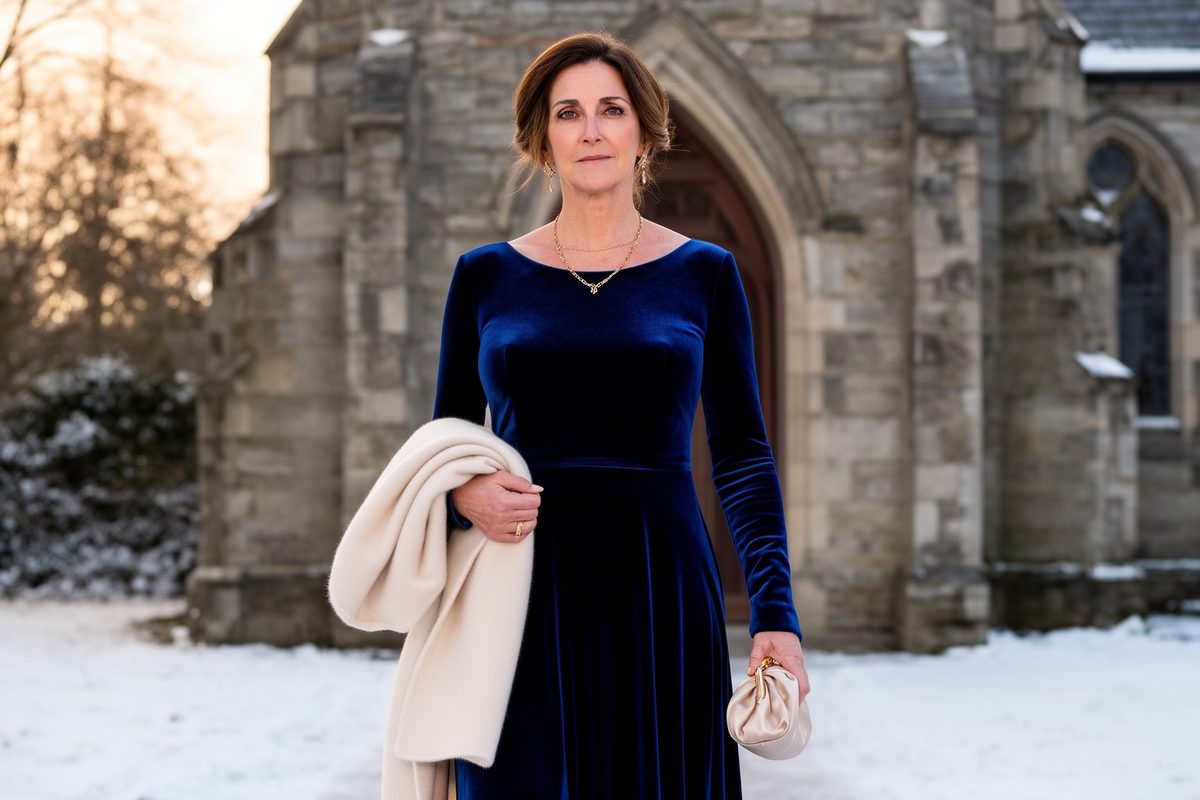
A coat is the piece of clothing other people see most and the piece most of us think about least. You wear it every day for four months, in every photograph taken of you outdoors, over every outfit you carefully assembled and then covered up. It is also the single item where buying well pays back the longest, because a good wool coat lasts a decade and a bad one pills by February.
Here are the five coat shapes that matter for winter 2026, which body each suits, and the honest case for finally buying one in a color that is not black.
The Five Shapes
1. The Funnel Neck
The standout silhouette of the season. The neckline rises into a high collar that stands away from the throat, sometimes tall enough to reach your chin.
Refinery29's winter coat roundup makes the practical case for it: those exaggerated high necks are not only dramatic, they also keep wind and snow off your face. That is the real argument. A funnel neck replaces a scarf, which means one less thing to lose and no bulk between your coat and your chin.
Suits: long necks beautifully. If your neck is short or your bust is full, a very tall funnel can shorten your upper body and add visual weight at the chest. Try a medium height before committing to a dramatic one.
Wear it with: everything underneath kept lean. The collar is the event.
2. The Scarf Coat
A coat with an attached scarf panel, worn hanging loose down the front or wrapped around the neck. It has been one of the most-copied shapes of the last two seasons and it is still going.
Suits: nearly everyone, because the hanging scarf creates a long vertical line down the front of the body, which is the most reliably lengthening thing a coat can do. It is particularly good if you carry weight through the middle, since the vertical panels break up the width.
Wear it with: nothing else at the neck. The coat has opinions already.
3. The Oversized Wool Wrap, or Bathrobe Coat
Tie-front, no buttons, generous through the body. Editors have taken to calling it the bathrobe coat, which undersells it. The useful version is cut with real room so you can wear a chunky knit underneath, and with generous armholes that do not bind when you layer.
Suits: everyone, with one condition: the shoulder seam has to sit at or near your actual shoulder. Oversized does not mean the shoulder drops halfway to your elbow, which is what makes a coat look borrowed rather than chosen.
Wear it with: a belt tied rather than buckled, slightly off-center, and a lean trouser or a straight jean so the volume stays on top.
4. Shearling and Faux Fur Trim
The Penny Lane coat is back: shearling or faux fur at the collar and the cuffs, often on a suede or wool body. Animal print has expanded past leopard into cow, zebra, deer and giraffe, which is more fun than it sounds if you keep it to one piece.
Suits: best on frames that can carry visual weight at the collar. If you are petite or small-shouldered, keep the trim narrow and the coat length no longer than mid-thigh, or the coat wears you.
Wear it with: absolutely plain clothes. This coat is the outfit.
5. Suede, Especially a Suede Trench
Suede is one of the defining materials of the year, and a brown suede trench is the single most recommended update in coat coverage this season. It sits somewhere between a jacket and a coat in formality, which makes it the most useful thing to own in October and again in March.
Suits: everyone. A trench shape with a belt gives waist definition to straighter frames and marks the smallest point on curvier ones.
Wear it with: chocolate brown, cream, or burgundy, all of which have been the colors of the whole fall.
The Case Against Your Black Coat
Most of us own a black coat and buy another black coat. This is the season to stop.
Who What Wear's report on coat colors notes that while black still appears on the runways, brands are pushing new shades: soft white, apple red, mulberry, marine green, purple and cobalt. Editors separately point to tobacco grey, espresso brown and dove white as the versatile non-black options.
The practical reasons to switch:
Black is harsh against most faces after 40. Black next to the skin drains warmth from the complexion and emphasizes shadows, which is why a camel, cream or espresso coat makes you look rested in a way a black one does not. This is the same logic as choosing colors that flatter your skin tone.
A black coat makes every outfit underneath invisible. You spent the winter assembling outfits nobody sees. A camel coat over black clothes is a two-tone outfit; a black coat over black clothes is a shape.
Black wool shows everything. Lint, salt, dog hair, dust from a train seat. Espresso brown and tobacco grey hide all of it.
The three most useful non-black colors, in order: camel, which goes with absolutely everything and looks expensive at every price; espresso brown, which is the new neutral and is softer on the face than black; and burgundy, which has been the color of the season and reads as a deliberate choice rather than a default.
Choosing By Body Type
If your hips are your widest point: a coat that skims rather than clings below the waist, in an A-line or a soft wrap. Avoid a belt that pulls tight at the high waist and then flares abruptly. More in the pear guide.
If your shoulders are your widest point: soft shoulders, raglan sleeves, no epaulettes, no heavy fur collar. A wrap coat tied at the waist moves the emphasis down.
If you carry weight through the middle: a straight, unbelted coat worn open over a vertical line, or the scarf coat, whose hanging panels do the work for you.
If you are hourglass: a belted wrap or a trench, every time. Marking the waist is the whole advantage, as the hourglass guide explains.
If you are petite: mid-thigh to just below the knee, never mid-calf. A long coat on a short frame cuts the leg line in half.
What to Actually Spend
A coat is the clearest case for spending more rather than less, because the price difference shows at twenty feet.
The test that matters is the fabric. Look for a wool content above 70 percent. Below about 50 percent wool, with a high polyester share, the coat will pill at the sleeves and the collar inside one winter. Turn the cuff inside out in the shop and look at the lining seam; if it is already loose on the rack, walk away.
The second test is the shoulder. A coat that fits in the shoulder can be tailored anywhere else for very little. A coat that is wrong in the shoulder cannot be fixed at any price.
What you can skip: real fur, a designer label, and a hood on a formal coat. What you should not skip: lining, pockets with real depth, and a sleeve length that covers your wrist bone when your arm is bent.
Editors routinely find good options in the affordable brands, so the price is less important than the fabric content and the shoulder line. The same reasoning is in investment pieces worth the splurge.
The Three-Coat Wardrobe
If you want to stop thinking about this entirely, three coats cover an entire winter.
- A long wool coat in camel or espresso, straight or softly wrapped, for work, dinners and parties.
- A shorter practical coat with a funnel neck or a hood, in any dark color, for school runs, dog walks and bad weather.
- A suede or leather trench, for the six weeks either side of winter when a wool coat is too much, which transitional dressing covers in detail.
That is it. Everything else is a preference, not a need. For what goes under all three, see winter elegance, and if you want the shape worked out on your own frame, upload a photo to the FreeDiva stylist and it will read your proportions and tell you which silhouette to look for.
Want Personalized Outfit Recommendations?
Upload a photo and let our AI stylist create complete outfits tailored to your body type, skin tone, and personal style.
Try AI Stylist