Men's body types come down to how your shoulders, waist and hips compare: a trapezoid has shoulders a little wider than an even waist and hips, an inverted triangle has broad shoulders over narrow hips, a triangle is wider at the hips than the shoulders, an oval carries weight through the middle, and a rectangle is about the same width all the way down. Dressing any of them starts in the same place, the shoulder seam of the jacket, because it is the one part a tailor cannot really fix. Everything else, from jacket length to trouser rise, is chosen to move the eye toward what you want seen.
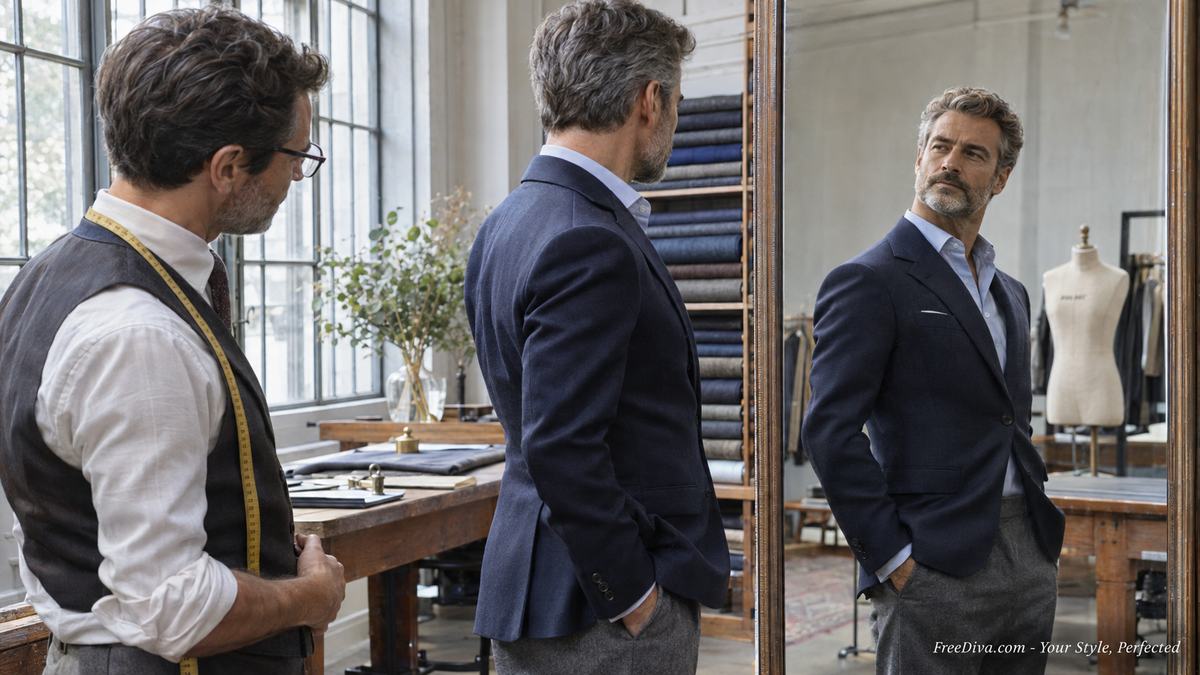
That shoulder point is not a stylist's opinion. Simon Crompton of Permanent Style titled a post on alterations "Change anything but the shoulders", and Derek Guy's fit checklist at Put This On asks that "the ends of your jacket's shoulders should generally coincide with the ends of your natural shoulders." Sleeves, waist suppression and trouser hems are routine work at any alterations counter. A shoulder that is two inches too wide is a different jacket.
How do I know my body type as a man?
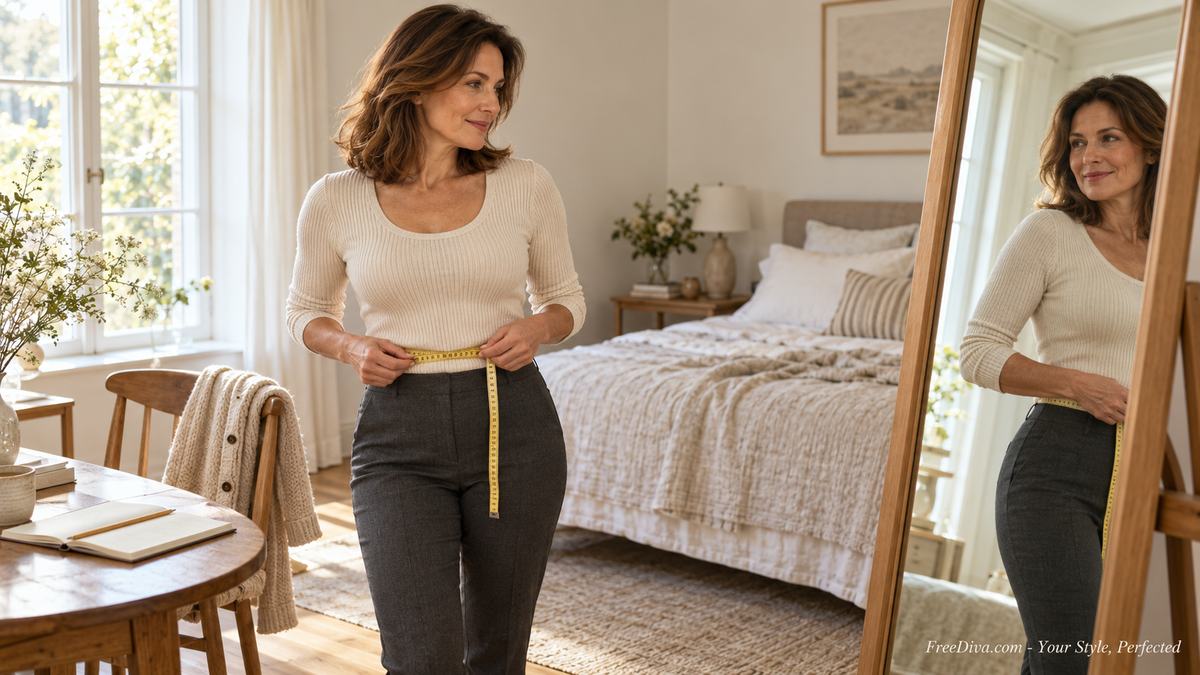
Stand in front of a mirror in a fitted T-shirt and look at your outline, or better, take three measurements with a soft tape: chest at the fullest point, waist at the narrowest, hips at the widest. Use the same unit for all three. Our guide to measuring your body shape at home is written for women, but the tape goes in the same places and the ratios below are the same ones FreeDiva uses:
- Oval: your waist is 85% or more of your chest or hips, whichever is larger.
- Trapezoid: chest and hips within 5% of each other, with a waist clearly smaller (75% or less of them).
- Inverted triangle: chest at least 5% larger than hips.
- Triangle: hips at least 5% larger than chest.
- Rectangle: everything else, an even line with no strong difference.
A chest tape exaggerates shoulders a little and photos do worse: a coat, a loose shirt or arms resting against your sides hide the waist entirely. If a photo reading surprises you, trust the tape.
Two numbers worth knowing before you shop. The drop of a suit is the gap between the jacket's chest size and the trouser waist: a 42 jacket sold with 36 trousers is a drop 6. Brands do not agree on which drop is "regular", so read the size chart, but "athletic" cuts always mean a bigger drop, for a bigger chest-to-waist gap. And the rise of a trouser is where the waistband sits. Sven Raphael Schneider of Gentleman's Gazette puts it simply: low rise rests at the hip bones, mid rise between the navel and hip, high rise at the natural waistline.
The five shapes at a glance
| Shape | Jacket | Trousers | Skip |
|---|---|---|---|
| Trapezoid | Single-breasted, true size | Slim or straight | Oversized everything |
| Inverted triangle | Soft, unpadded shoulders, notch lapels | Straight, with room in the thigh | Skinny legs, heavy padding |
| Triangle | Some padding, wider or peak lapels | Dark, straight, natural waist | Short jackets, light trousers |
| Oval | Single-breasted, worn open, mid lapels | Mid-to-high rise | Clingy knits, contrast belts |
| Rectangle | Structured shoulders, layers | Straight, any rise | One shapeless block |
Trapezoid: the build the racks are cut for
A trapezoid has shoulders a little wider than his waist and hips, and his chest and hips are close in width with a visible waist between them. Most ready-to-wear is drafted for roughly this man, so his job is the easiest and the most often fumbled: he buys his true size, or he gets lazy and buys a size up because it feels comfortable.
Buy the jacket that fits at the shoulder and closes over the chest without an X of pulling around the button. Single-breasted, two buttons, medium lapels. Shirts that follow the torso without straining at the buttons. Trousers slim or straight, with a hem that just touches the shoe. That is genuinely the whole program. The one thing to watch is time: the trapezoid at 45 who keeps buying the slim fit he wore at 32 turns into an oval in a slim fit, which is the least kind combination there is.
Inverted triangle: broad shoulders, narrow hips
The inverted triangle has a chest and shoulders noticeably wider than his hips: swimmers, rowers, men who lift, and some men who were simply built that way. Off-the-rack jackets fit his shoulders and billow at the waist, or fit his waist and strain at the back. An athletic-cut jacket with a bigger drop helps, and a tailor taking in the waist helps more.
The aim is to soften the top and add a little weight below. Gentleman's Gazette tells this build to skip shoulder padding unless the shoulders slope, keep to notch lapels rather than wide peaks, and stay single-breasted, because "double breasted suits will look too wide" (Gentleman's Gazette). Unstructured jackets in cotton, linen or soft wool do the same job off duty. Make sure the sleeves are cut with room for bigger arms; a tight sleeve tells everyone the jacket is a size too small.
Below the belt, go straight or relaxed with real room through the thigh. Skinny trousers under a big chest look like a cartoon of a strong man. On top, open collars, V-neck knits and a little texture break up the width; bold horizontal stripes across the chest make it wider still.
Triangle: narrower shoulders, fuller hips
A triangle measures wider at the hips than the chest, often with sloping shoulders and some weight carried low. He is the shape the menswear rules talk about least, and the one a good jacket helps most.
Build the top. A little shoulder padding, a cleanly set sleeve head, and lapels with some width, Gentleman's Gazette suggests peaks around 3 3/4 to 4 inches, widen the upper half. Lighter or patterned shirts work on top, darker plain trousers below. The jacket length matters more here than for anyone: it should cover the seat and end below the widest point of the hips. Put This On's rule of thumb is a hem roughly halfway between the collar and the floor, and on a triangle a fashionably short jacket stops exactly where you least want a line.
Trousers: dark, straight, sitting at or near the natural waist, with nothing bulky on the hips. Cargo pockets and stuffed side pockets add width right where you have it. Tight tops tucked into light-colored chinos are the outfit to retire.
Oval: a fuller middle
An oval carries his weight through the midsection: his waist is as wide as, or wider than, his chest and hips. The goal is a long, unbroken vertical line and fabric that skims instead of clinging.
Three things do most of the work. First, rise: a waistband that sits below the belly folds under it and slides down all day. Schneider notes that a high rise is more comfortable if you carry weight in your abdomen, and that "a higher waistline also helps disguise your belly." Many men find a mid-to-high rise the comfortable middle; try them sitting down before you buy. Second, color: a dark jacket over a dark shirt, or tonal navy on navy, draws one tall shape. A white shirt and a contrasting belt cut you in half at the widest point. Third, the jacket: single-breasted and often worn open, so its edges make two vertical lines down the front. Double-breasted adds width, and skinny lapels make everything around them look larger.
Shirts need a little room through the body. A shirt cut for wearing untucked, with a straight hem ending around mid-fly, is a better casual choice than a tucked shirt held by a belt. Knits should be medium weight; thin jersey and fine-gauge merino show every contour.
Rectangle: straight up and down
A rectangle's shoulders, waist and hips measure about the same. He is often slim, sometimes not, and his clothes tend to hang off him in one straight block from neck to knee.
He wants the opposite of the inverted triangle: shoulders with some structure, layers that add depth, and texture. A tweed or flannel jacket with a defined shoulder, an overshirt over a knit, a vest under a suit jacket. Gentleman's Gazette suggests slim men try bolder patterns like houndstooth or windowpane, and lapels of middle width rather than skinny ones. A belt or a tucked shirt adds a waist where the body does not show one. Avoid very long, shapeless tops and a single color top to bottom.
Fit rules every shape shares
Four checks apply to every build, and they matter more than which shape you are:
- Shoulders first. The seam ends where your shoulder ends. No dent below it (too wide), no pull across the upper arm (too narrow).
- A jacket that covers your seat, roughly halfway between collar and floor.
- About a quarter to half an inch of shirt cuff showing past the jacket sleeve.
- Trousers that touch the shoe with a slight break or none. Pooling fabric at the ankle shortens every man.
Spend on the pieces you wear weekly, and send everything to a tailor before its first wearing; a sleeve and hem alteration does more for a jacket than a more expensive label. The logic is the same as in our piece on investment pieces worth the splurge, and if you share a closet with someone who already reads this blog, her version of body-type dressing runs on the same principles with different names.
Do body types change with age?
Yes, and that is the most common reason a man's clothes stop working. Weight tends to move to the middle in midlife, so a trapezoid or rectangle in his thirties can measure as an oval at 55, and his shoulders may slope more. Re-measure every couple of years rather than buying by the size on the old label. The shapes are a starting point, not a verdict; as we argue in body type myths debunked, proportion and fit beat any category.
Color does part of the work too: a dark, low-contrast outfit narrows and a bright one draws the eye, which is why the colors that flatter your skin tone matter as much for a navy suit as for a dress.
Quick answers
What is the most common male body type?
There is no reliable published census of male body shapes. What is true is that off-the-rack menswear is drafted around a balanced, moderately tapered build, so men close to the trapezoid find the most that fits.
Should a man with a belly wear a belt?
A belt is fine if it matches the trousers closely in color so it does not draw a line. Gentleman's Gazette goes further and suggests suspenders instead, which hold a higher-rise trouser in place without a strap across the widest point.
Can a tailor fix jacket shoulders?
Only in small ways, and usually at a price close to a new jacket. Buy for the shoulders and have the sleeves, waist and length altered.
FreeDiva has a Women's/Men's looks button, and in Men's it names your build the men's way, from a photo or from your chest, waist and hip measurements. If you would rather see it than read it, upload a photo to the FreeDiva stylist and pick Men's looks: you get three outfits cut for your shape.
Want Personalized Outfit Recommendations?
Upload a photo and let our AI stylist create complete outfits tailored to your body type, skin tone, and personal style.
Try AI Stylist