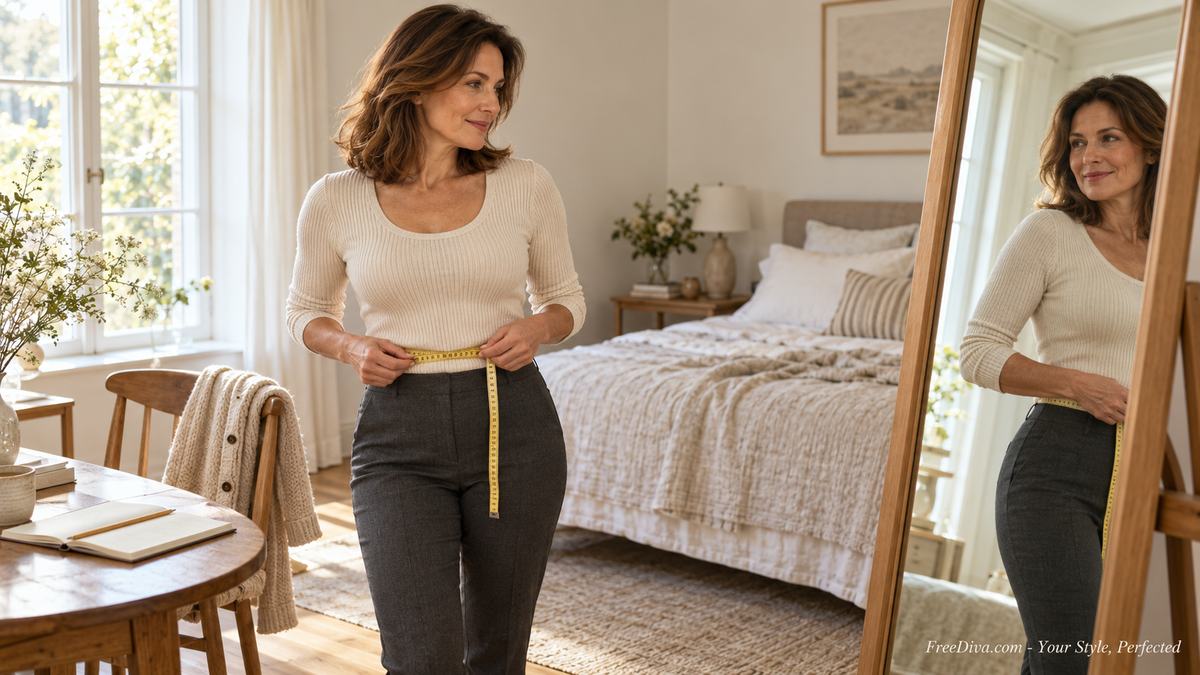
To find your body shape, measure three places with a soft tape: the fullest part of your bust, the narrowest part of your waist and the fullest part of your hips. Then compare them. If your waist is 85% or more of your larger measurement, you are an apple. If bust and hips are within 5% of each other and your waist is 75% or less of the smaller one, you are an hourglass. Hips 5% or more bigger than bust is a pear, bust 5% or more bigger than hips is an inverted triangle, and anything else is a rectangle.
That is the whole method, and it takes five minutes. The rest of this guide is about doing it accurately, because a tape in the wrong place by an inch or two can move you from one shape to the next, and about what to do when your numbers sit right on a line.
What you need before you start
A soft, non-stretch tailor's tape, a mirror (a full-length one is easiest), and a pencil. Wear a thin top or just the bra you wear most days, an unpadded one if you can, since padding adds to the bust number and a minimizer takes away from it. Stand barefoot with your feet together and your weight even on both feet.
Two habits ruin more measurements than anything else. The first is pulling the tape tight to get a smaller number. It should lie flat against you without pressing in. The second is letting the tape tilt: it dips at the back, where you cannot see it, and adds an inch. Check it in the mirror every time.
Where exactly do you measure bust, waist and hips?
Clothing brands describe the three points almost identically. Nike's women's size guide is typical: "Measure around the fullest part of your bust, keeping the measuring tape horizontal," then the waist at "the narrowest part (typically where your body bends side to side)," then "the fullest part of your hips." Here is what that means in practice.
Bust
Wrap the tape around your back and across the fullest point of your bust, usually the nipple line. Keep it level across your shoulder blades. Let your arms hang relaxed; lifting them raises the tape and shrinks the number.
Waist
Your natural waist is the narrowest part of your torso, often a little above the belly button. To find it, bend to one side: the crease that forms is your waist. Breathe out normally and measure there without sucking in. If you have no obvious narrow point, measure about an inch above your navel and note that you had to guess. That fact matters later.
This is not the same waist your doctor measures. Health guidance based on the NIH protocol, such as Kaiser Permanente's instructions, puts the tape "at the top of your hipbone," usually around belly-button height, and gives under 35 inches as the target for women. That number is for tracking health. For body shape and clothes, use the narrowest point.
Hips
Stand with your feet together and slide the tape up and down over your seat until you find the widest point, measured all the way around, including the fullest part of your bottom. For many women it sits lower than they expect, closer to the top of the thighs than the hip bones. Look sideways in the mirror to make sure the tape is level at the back.
Write all three numbers down. Measure each one twice; if the two readings differ by more than half an inch, do a third and keep the middle one.
The ratios that decide each shape
FreeDiva uses the same rules on /style when you type in your measurements, and they work in inches or centimeters, since they compare proportions rather than absolute sizes. They are checked in this order, and the first rule that fits is your shape.
| Shape | The rule, in plain words | What it looks like |
|---|---|---|
| Apple | Waist is 85% or more of your bust or hips, whichever is bigger | A fuller middle, waist about as wide as bust or hips |
| Hourglass | Bust and hips within 5% of each other, and waist 75% or less of the smaller one | Bust and hips about equal, a clearly smaller waist |
| Pear | Hips 5% or more bigger than bust | Hips wider than bust or shoulders |
| Inverted triangle | Bust 5% or more bigger than hips | Shoulders or bust wider than hips |
| Rectangle | None of the above | Bust, waist and hips about the same |
The order matters. A woman whose waist is 86% of her hips is an apple even if her hips are also much wider than her bust, because the fuller middle is what shapes how clothes hang on her. And the hourglass rule is strict: equal bust and hips are not enough, the waist has to be clearly smaller as well.
To check a rule without a calculator, multiply. For the apple rule, take your larger measurement and multiply by 0.85. For the hourglass waist, multiply your smaller measurement by 0.75. For the 5% rules, multiply the smaller of bust and hips by 1.05.
A worked example in inches
Say you measure a 38 inch bust, a 30 inch waist and 41 inch hips.
- Apple? The larger measurement is 41. 41 x 0.85 = 34.85. Your waist, 30, is under that, so no.
- Hourglass? Bust and hips differ by 3 inches. 5% of 41 is 2.05, and 3 is more than that, so no.
- Pear? 38 x 1.05 = 39.9. Your hips, 41, are bigger than 39.9, so yes. You are a pear.
Now change one number. With hips of 39.5 instead of 41, step 3 fails (39.5 is under 39.9), step 4 fails too (your bust is not bigger than your hips), and you land on rectangle. Half an inch of tape separates the two answers, which is why the section on sitting between shapes below matters as much as the table.
A second quick one: 37 inch bust, 28 inch waist, 38 inch hips. Bust and hips are only an inch apart, inside 5%. But 37 x 0.75 = 27.75, and your waist is 28, a quarter of an inch over. Rectangle, by the rules, and very nearly hourglass. If your measurements look like this, read the hourglass advice as well as the rectangle advice.
Why does a photo get my body shape wrong?
A photo shows an outline, and an outline is easy to fool. Three things do most of the damage.
- A coat, a blazer or a loose top. Fabric that falls straight from the bust hides the waist entirely, so any reading from the outline sees bust, waist and hips as about the same and calls you a rectangle, or an apple if the fabric bells out.
- Arms at your sides. In a relaxed pose your arms touch your torso at the waist, and the outline widens right at the point that should be narrowest.
- Angle. Stand a little turned, or hold the camera at chest height or above, and the proportions between top and bottom shift.
Measurement itself is less exact than it sounds, even in a lab. A 2021 study in the journal Ergonomics by Parker, Hayes, Brownbridge and Gill took 1,679 3D body scans and found that small differences in where the measurements were placed changed the shape a body was sorted into in up to 40% of cases. If a scanner can be that sensitive, a phone photo of a woman in a winter coat has no chance, and a tape held carefully by you is the better source.
FreeDiva's photo stylist on /style reads a shape from your photo, but it says so when the waist is hidden and its reading is only a guess. In that case it asks you to pick your shape, or to type in your bust, waist and hips, and it uses the rules in the table above. Your choice overrides the photo, and the site remembers it next time.
What if I am between two body shapes?
Most women are, at least a little. The categories are a shorthand for how clothes will hang, not a diagnosis, and the common myths about body types mostly come from treating them as fixed. Here is how to use a borderline result.
Find the rule that nearly went the other way. In the 37-28-38 example, the waist missed the hourglass rule by a quarter inch. That tells you your waist is well defined and worth showing, so wrap dresses and belts will work, and so will the straighter shapes a rectangle wears.
Decide by your fit problems, not the label. If trousers that fit your hips gape at the waist, dress like a pear or an hourglass, whatever the tape says. If dresses that fit your hips pull across the bust or shoulders, take the inverted triangle advice seriously.
Remember the shoulders. The tape rules compare bust and hips, but the inverted triangle is just as often about broad shoulders with a modest bust. The Ergonomics paper above makes the same criticism of the research standard, which leaves shoulder width out. If your shoulders are clearly wider than your hips, choose inverted triangle on /style even if the tape says rectangle.
Measure again after a change. Shape moves with weight, menopause and strength training. If your body has changed after 35, your measurements from five years ago are not your shape now.
What to read for your shape
Once you have an answer, each shape has its own guide:
- Pear: how to balance pear proportions
- Apple: styles that define an apple waist
- Hourglass: outfits that follow hourglass curves
- Rectangle: creating curves on a rectangle
- Inverted triangle: balancing broad shoulders
And for all five side by side, start with the complete guide to dressing for your body type.
Quick answers
Should I measure over clothes?
Over a thin top or your usual bra, yes. Over a sweater or jeans, no: a thick waistband alone can add an inch to your waist and push you toward apple.
Do the ratios work in centimeters?
Yes. Every rule is a percentage, so any unit works as long as all three measurements are in the same one.
My bust and hips are equal but my waist is not very small. What am I?
By these rules, a rectangle. Hourglass needs the waist at 75% or less of the smaller of the two. If yours is close, wear what suits both shapes.
Which number should I use if my weight goes up and down?
Measure on an ordinary day, not your lightest. Clothes have to fit the body you live in most of the month.
If you would rather skip the arithmetic, type your three numbers into the FreeDiva stylist along with a photo, and it will work out your shape and build three complete looks around it.
Want Personalized Outfit Recommendations?
Upload a photo and let our AI stylist create complete outfits tailored to your body type, skin tone, and personal style.
Try AI Stylist

