To dress in your 50s without looking dated, change the details that carry a date stamp, not your whole style: wear pants that reach the shoe, swap heavy round-toe shoes for slimmer shapes, carry a smaller structured bag, choose jackets with natural shoulders, and fit clothes to the body you have now. Age is rarely what makes an outfit look old. A pant length, a toe shape or a jacket cut from fifteen years ago does that, and every one of them can be fixed.
That is the good news, and it is genuinely good. Nobody looks at a well-dressed woman of 54 and thinks "too old for that." They think "that looks current," or they think "that looks like 2011." The second one is what we are going to fix, one tell at a time.
What Makes an Outfit Look Dated After 50?
Fashion dates itself through proportion far more than through color or print. A navy sweater is never dated. A navy sweater that ends at the high hip over a skinny ankle pant and a chunky round-toe flat is, because that whole silhouette belongs to a specific decade. Here are the six places the date stamp usually hides.
1. The Pants: Length and Leg Shape
The tell: skinny or ultra-slim pants cut at the ankle bone, a low or mid rise, and a hem that shows a strip of skin above a ballet flat. That was the default for the whole skinny-jean era, and the eye now reads it as that era.
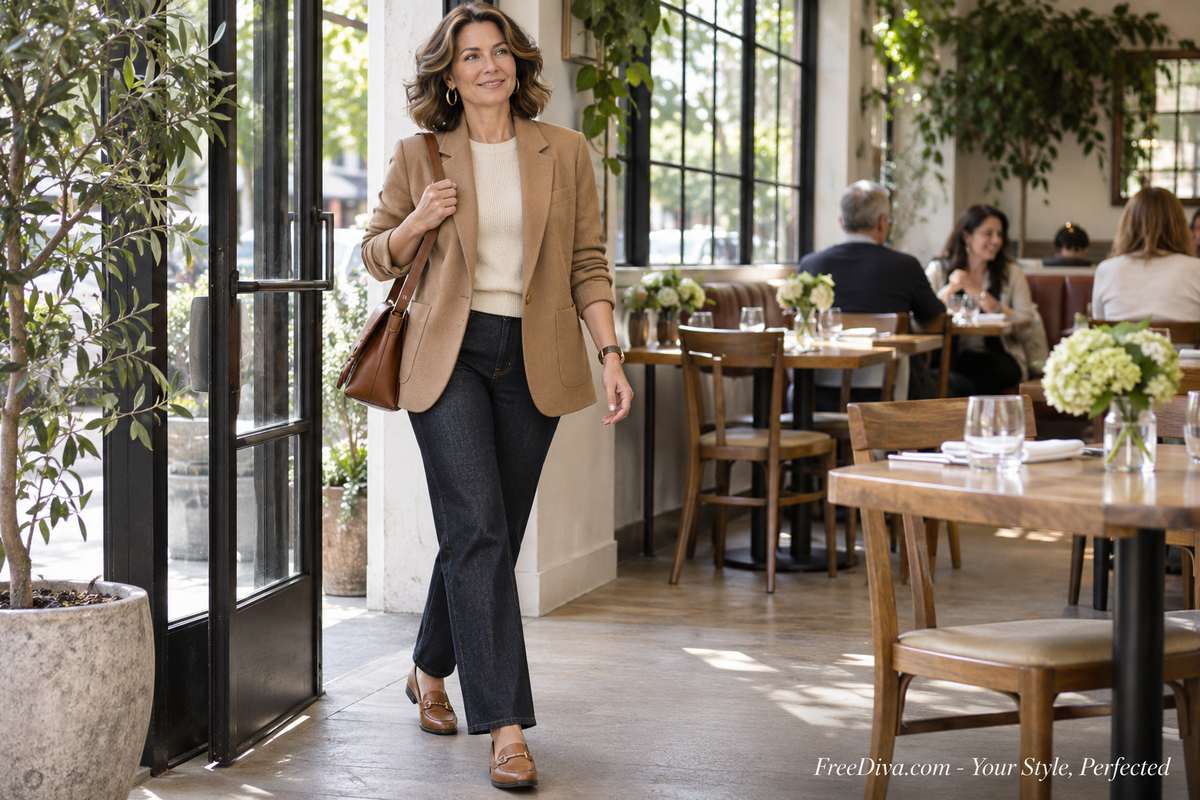
The update: a straight, slightly wide or soft wide leg, high or true-mid rise, and a full length that touches the top of the shoe or covers most of it. With a flat, the hem should brush the shoe. With a heel or boot, it can fall lower. This is the single fastest update in the whole list, because the pant sets the proportion for everything above it.
If you love your skinny jeans, you do not have to throw them out. Wear them with a longer, looser top or under a knee-length coat and a slim boot, so the narrow leg reads as one line rather than the whole statement. Fashion editor and stylist Lois Joy Johnson puts the principle simply in her AARP list of outfit mistakes after 50: balance a tight bottom with a looser top, or a clingy top with a looser bottom.
Denim is its own subject, with rise, stretch and pocket placement all mattering. We went through it piece by piece in how to find jeans that actually fit.
2. The Shoes: Toe Shape and Weight
The tell: the clunky round-toe "comfort" shoe in black, the very high platform pump, the cork wedge sandal, and athletic sneakers worn as everyday shoes. Shoes also age a look by being visibly worn: collapsed heels, scuffed toes, salt lines on boots.
The update: an almond or softly pointed toe, a slimmer profile, and a lower heel. Loafers, low block-heel ankle boots, kitten-heel slingbacks and clean white leather sneakers all read current and all walk well. Pointed and almond toes make the leg look longer, which a round blunt toe never does.
Comfort is not optional, and it is not the enemy of style. Your feet genuinely change: a Cleveland Clinic podiatrist explains that worn ligaments let the arch slowly collapse, which makes the foot a bit longer or wider, and that the fat pads under the foot thin with age. Her advice is to get measured every so often instead of assuming your size. If you have bought the same size for twenty years, check it: a shoe that pinches is the shoe that gets swapped for the ugly one. Buy the right size in a better shape. The fall 2026 shoe trends are kinder here than they have been in years, with plenty of low heels.
3. The Bag: Size and Hardware
The tell: the huge slouchy hobo, the bag covered in logo print, heavy chains and studs, and the cross-body nylon travel bag worn every day of the year.
The update: a medium structured bag in good leather, with one small piece of hardware or none. A top handle, a shoulder bag that tucks under the arm, or a neat leather cross-body all work. A structured shape makes the whole outfit look more deliberate, and a smaller bag stops you carrying a pound of things you do not need. Johnson's rule on branding is worth stealing: one or two branded items in an outfit at most.
A good bag is one of the few places where spending more pays back for years. It is near the top of our list of investment pieces worth the splurge.
4. The Jacket: Shoulders and Length
The tell: the short, tightly fitted blazer with a single button at the waist, sharp padded shoulders from an older cycle, shrunken cropped cardigans, and the long, thin waterfall cardigan that droops at the front.
The update: a relaxed blazer with natural or softly squared shoulders that ends at the hip or just below, worn open. It skims rather than grips, so it looks good over a tee, a knit or a dress. For knits, a straight cardigan that reaches the top of the hip, or a longer coatigan in a dense knit that holds its shape.
Watch the sleeve length. A sleeve that covers the knuckles reads sloppy, and one that hits above the wrist bone reads shrunken. You want the sleeve to end at the wrist so a bit of shirt cuff or bracelet shows.
5. The Fit: Too Tight or Too Much
The tell: this one goes both ways. Clothes bought for the body you had at 45, now pulling across the bust, hips or upper arms. Or the opposite: oversized everything, in the hope of hiding a changed middle, which Johnson rightly says makes you look "bigger, boxier and shapeless."
The update: fit to the body you have today, and show three small areas. Johnson's suggestion is the neck, the forearms and the ankles, and it works because those spots tend to stay slim and they break up a column of fabric. A V or open collar, a sleeve pushed to the forearm, and a hem that shows the ankle (or a slim shoe) are the difference between relaxed and swamped.
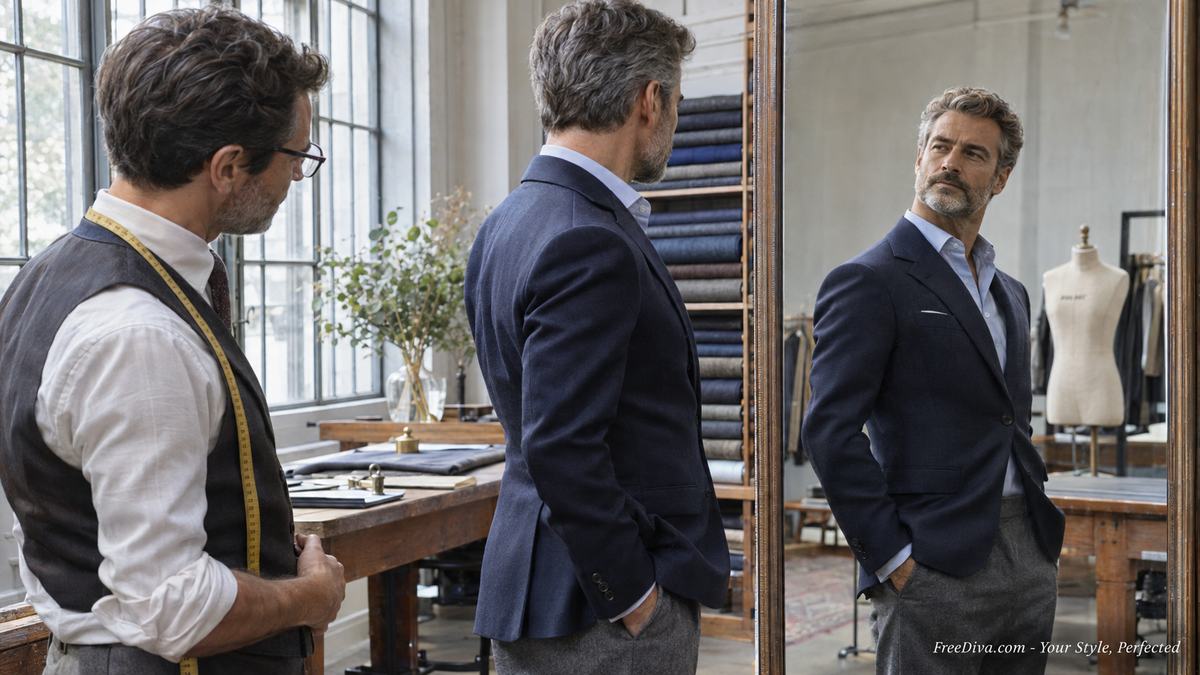
Then take your favorite pieces to a tailor. Taking in a waistband, shortening a sleeve or adjusting a hem costs far less than replacing a good jacket, and it is what makes a mid-range piece look expensive. If you are rebuilding the closet anyway, a capsule built on quality gives you fewer pieces worth tailoring.
6. Hair and Makeup Habits
The tell: the haircut or color you have had since your 30s, kept because it is familiar. Heavy matte powder foundation, thin over-plucked brows drawn in hard, frosted shimmer all over the lid, and dark lip liner around a lighter lipstick. None of these are crimes. They simply carry a year.
The update: a cut with some movement and softness around the face, and color that works with your skin as it is now. That may mean going gray on purpose, which reads modern when it is cut well and kept glossy. In makeup, think thinner layers: a sheer or skin-like base where you need it, cream blush instead of powder, brows that are filled softly in a shade near your hair, and a lip color with a little moisture. If your coloring has changed with your hair, the shades that suited you at 35 may not now. Our guide to makeup colors for your skin tone walks through how to pick them.
How Does Your Body Change in Your 50s?
The changes are real, and pretending otherwise leads to clothes that do not fit. But they are changes in where to put the emphasis, not reasons to disappear.
The waist moves. Before menopause, many women carry fat around the hips and thighs. As estrogen declines, Cleveland Clinic's menopause specialists note, fat distribution can shift toward the abdomen, and muscle mass tends to decline with age. In practice, the waist is less defined than it was, and many women who were pear-shaped find themselves closer to a rectangle or an apple.
How to dress for it, without hiding:
- Define the waist loosely rather than tightly. A soft half-tuck, a wrap that crosses at the narrowest point (often just under the bust), a belt worn slightly loose over a long cardigan or coat.
- Choose fabrics with drape. Fluid crepe, silk-like satin, jersey with weight, and fine merino all skim the midsection. Stiff cotton poplin and thin clingy knit do the opposite.
- Lengthen the line. A long open layer over a column of one color creates a vertical stripe down the center of the body. That is the one silhouette that flatters every body, and in your 50s it does a lot of work.
If the midsection is your main concern, our apple shape guide has outfit-by-outfit detail.
The feet change, as above. Get measured, buy for the foot you have, and look for a wider toe box in a still-elegant shape.
Your coloring shifts. As hair grays or lightens, the contrast between hair, skin and eyes often softens. Colors that were striking against dark hair can now overpower you, or the reverse, a gray head can look wonderful against clear saturated colors you never tried. Hold the color under your chin in daylight and look at your face, not the fabric. Our guide to colors that flatter every skin tone explains how to test this properly.
For the longer view of how a body changes through the decades, and why style should follow, read how your body changes after 35.
The Old Rules to Stop Believing
Most "rules" for women over 50 were invented to keep women quiet, and none of them have a basis beyond habit. Retire these:
- "Cut your hair short after 50." Length is about your hair's thickness and condition, not your age. Long hair that is healthy and cut with shape looks current. Long hair that is thin and straggly at the ends does not, at any age.
- "No sleeveless." If you like your arms, show them. If you do not, a cap sleeve, a three-quarter sleeve or a light layer works. Either way it is a preference, not a law.
- "No jeans after a certain age." Jeans are one of the most useful things in a grown woman's closet. The cut is what matters, not the denim.
- "Stick to neutrals and navy." Color near the face often does more for a woman in her 50s than any cream. A deep teal, a berry, a clear red: try them.
- "Cover up with a tunic." A tunic over leggings is the outfit that most reliably adds years. Fit and drape do what the tunic was meant to, without the shapelessness.
We took apart the body-type version of these rules in why body type rules are meant to be broken. The age version deserves the same treatment.
Where to Start This Week
You do not need a new wardrobe. You need to find the date stamps in the one you have. Try this in one afternoon:
- Put on your most-worn pants with your most-worn shoes and look at the hem in a full-length mirror. If there is a gap of skin and a round-toe flat, that is your first purchase: one pair of full-length straight or wide-leg trousers.
- Line up your shoes. Anything visibly worn, painful or with a blunt heavy toe goes to the back. Replace one pair with an almond-toe loafer or a low ankle boot, in the size your foot is now.
- Try on every jacket and cardigan. Keep what fits at the shoulder and hits at the hip. Take the near-misses to a tailor.
- Book the haircut. Ask for movement and softness, and bring a picture of a cut on a woman your age that you admire.
That is four changes, and together they will do more than a dozen new trend pieces.
And if you would like a second opinion on where your own date stamps are hiding, upload a photo to the FreeDiva stylist. It reads your body shape and coloring from the picture and builds three complete looks around them, so you can see what the update would look like on you before you buy a thing. In December we follow this up with how to dress in your 60s, for everyone who wants to read ahead.
Want Personalized Outfit Recommendations?
Upload a photo and let our AI stylist create complete outfits tailored to your body type, skin tone, and personal style.
Try AI Stylist