The little black dress became a fashion idea in October 1926, when American Vogue published a drawing of a simple black Chanel day dress and compared it to Henry Ford's car: a design everyone would own. But Chanel did not invent it. Black had been the color of mourning and of working uniforms for a century, and other Paris houses were already selling plain black dresses. What changed in the 1920s was that black stopped meaning grief or service and started meaning chic.
That is the short answer. The longer one is better, because nearly every famous story about this dress is slightly wrong, and the true version tells you more about how to wear one now.
Before the dress: black meant grief or work
For most of the 1800s, a woman in head-to-toe black was telling you something about her life, not her taste. Mourning dress had strict stages, and a widow was expected to wear dull black crape for months before moving to corded silks, then gray and mauve. The Met's Costume Institute traced exactly that progression in its 2014 exhibition Death Becomes Her: A Century of Mourning Attire, which covered 1815 to 1915 and included mourning gowns worn by Queen Victoria and Queen Alexandra. Royal mourning rules spread to ordinary women through fashion magazines.
The other women in plain black were the ones working: maids, shop assistants, servants. As Smithsonian Magazine puts it, simple black clothing before the 1920s belonged to servants or to mourning, not to high fashion.
Black itself was never only sad. The fashion historian Liz Gessner, in the Encyclopedia of Clothing and Fashion, notes that Philip the Good, Duke of Burgundy, dressed only in black in the 15th century. But by the 19th century a black dress on a woman read as either respectable or bereaved, and rarely as glamorous.
Then came 1914 to 1918. The First World War, followed by the flu pandemic, left France full of widows, and black became ordinary daywear on the street. Chanel, more than anyone, saw that a color everyone already owned could be made modern.
1926: the drawing Vogue called a Ford
On October 1, 1926, American Vogue ran a drawing of a Chanel dress: black crepe de chine, long sleeves, a low belt line, worn with pumps, pearls and a cloche hat. The magazine compared it to the Model T, the car Henry Ford famously sold in any color as long as it was black. The point of the comparison was not that the dress was cheap. It was that it was a standard: a simple, well-made design that could be copied and worn by huge numbers of women.
Sources do not agree on the exact wording. Smithsonian says Vogue called the dress "The Ford". The Museum at FIT says Vogue dubbed it a "Fashion Ford", and the Met, in its notes on a later Chanel dress, uses "Ford of Fashion". Most popular histories call it "Chanel's Ford". Whatever the headline, the idea stuck.
You can see what Vogue meant at the Met, which holds a Chanel ensemble from about 1927 that it describes as representing the little black dress, "one of Chanel's most popular and enduring contributions to women's fashion". It borrows tailoring details from riding habits and menswear, and that is the real innovation: a woman's dress built with the plainness and ease of a man's suit.
Who really invented the little black dress?
Not Chanel, at least not alone. This is the biggest myth in the story, and the museums themselves correct it.
The Museum at FIT's record for a Chanel evening dress of about 1926, in black silk satin with an ecru lace yoke, says plainly that crediting Chanel with "inventing" the little black dress is not quite accurate. The house of Premet had already sold huge numbers of simple black dresses, including a model called "La Garconne" with a white lace collar, years before Chanel's. Gessner's encyclopedia entry agrees: Chanel claimed to have invented it, and that claim "has found its way into fashion mythology", but many designers were working on the same idea at the same moment.
Chanel herself was making black long before 1926. The V&A owns an ankle-length black silk georgette evening dress she designed in 1922 for spring and summer 1923, embroidered in gold thread. It is beautiful, and it is not little at all.
There is also a well-loved anecdote in which the designer Paul Poiret sees Chanel in black and asks whom she is mourning, and she answers, "For you, monsieur." It is repeated everywhere and sourced nowhere. Treat it as a good line, not a fact.
What Chanel deserves credit for is fame and reach. FIT's own verdict is that she was highly influential in popularizing the style, and that is fair. Her version was short, plain and wearable, and a magazine with enormous reach told American women it was the new standard.
The 1940s and 1950s: one in every closet
The black dress lasted because it was useful. Gessner quotes Vogue in 1944: "Ten out of ten women have one." During the war years a dress that went from office to dinner, hid wear and needed only a change of jewelry was simply good sense.
After the war, Christian Dior made black a couture statement rather than a compromise. "You can wear black at any time," he said in 1954, the year his Little Dictionary of Fashion called black the most popular, the most convenient and the most elegant of all colors, words the V&A quotes beside a strapless black taffeta cocktail dress from about 1952, probably by Dior. The V&A calls it a cocktail or short evening dress, and that is the role the black dress settled into in the 1950s: fitted, short, for early-evening drinks rather than a formal dinner.
1961: the famous one is not little
In the opening scene of Breakfast at Tiffany's, Audrey Hepburn stands in front of Tiffany's window at dawn, eating a pastry, in black Givenchy with pearls, long gloves and dark glasses. It is probably the most copied black dress in history. It is also floor-length.
When Christie's sold one of the Givenchy versions in London on December 5, 2006, its catalog described a sleeveless, floor-length satin gown with a fitted bodice and a cut-out back. Estimated at 50,000 to 70,000 pounds, it went to an anonymous telephone bidder for 467,200 pounds, with the money going to the City of Joy Aid charity to build schools in Kolkata, as the Guardian reported. Givenchy had given the dress to the charity himself.
So when people say Hepburn wore "the" little black dress, they mean the idea, not the hemline. In the same film she wears shorter black dresses too, and it is the whole black-and-pearls look, more than one garment, that the world remembers. The often-repeated story that costume designer Edith Head had to rework the skirt because it showed too much leg rests on thin sourcing, so we will leave it there.
Later versions: the dress keeps changing its meaning
Once the dress was a standard, designers started arguing with it. Gessner calls the later 1960s a low point, the decade Balenciaga, a master of black, retired in 1968. In the early 1980s Rei Kawakubo and Yohji Yamamoto brought black back as a serious, almost severe choice, and designers like Azzedine Alaia made it sharp and body-conscious.
Chanel's own house kept answering its founder. For fall and winter 1987-88, Karl Lagerfeld sent out a little black dress in vinyl and polyester jersey, which the Met notes was made of materials worlds away from the original crepe de chine. The joke was the point: even a fabric made for raincoats still read as Chanel once it was cut short and black.
And on June 29, 1994, Princess Diana arrived at a Vanity Fair gala at London's Serpentine Gallery in a short, off-the-shoulder black silk dress by the Greek designer Christina Stambolian, on the same evening Prince Charles admitted infidelity in a television documentary. The press named it the revenge dress. It is due to be auctioned at Sotheby's in New York on December 9, 2026, with an estimate of $150,000 to $300,000, according to Gulf News. Black that once meant a widow's grief had become, 70 years later, the most confident thing a woman could wear.
If you like this kind of correction, our story on what the Pilgrims really wore takes apart another all-black myth.
How to choose a black dress for holiday parties after 40
A black dress is still the easiest answer to an invitation, but the one that looked right at 28 often does not now. Skin, hair and shape change, and black is less forgiving near the face than people think. Here is what actually matters.
Start with the neckline, because black sits next to your face
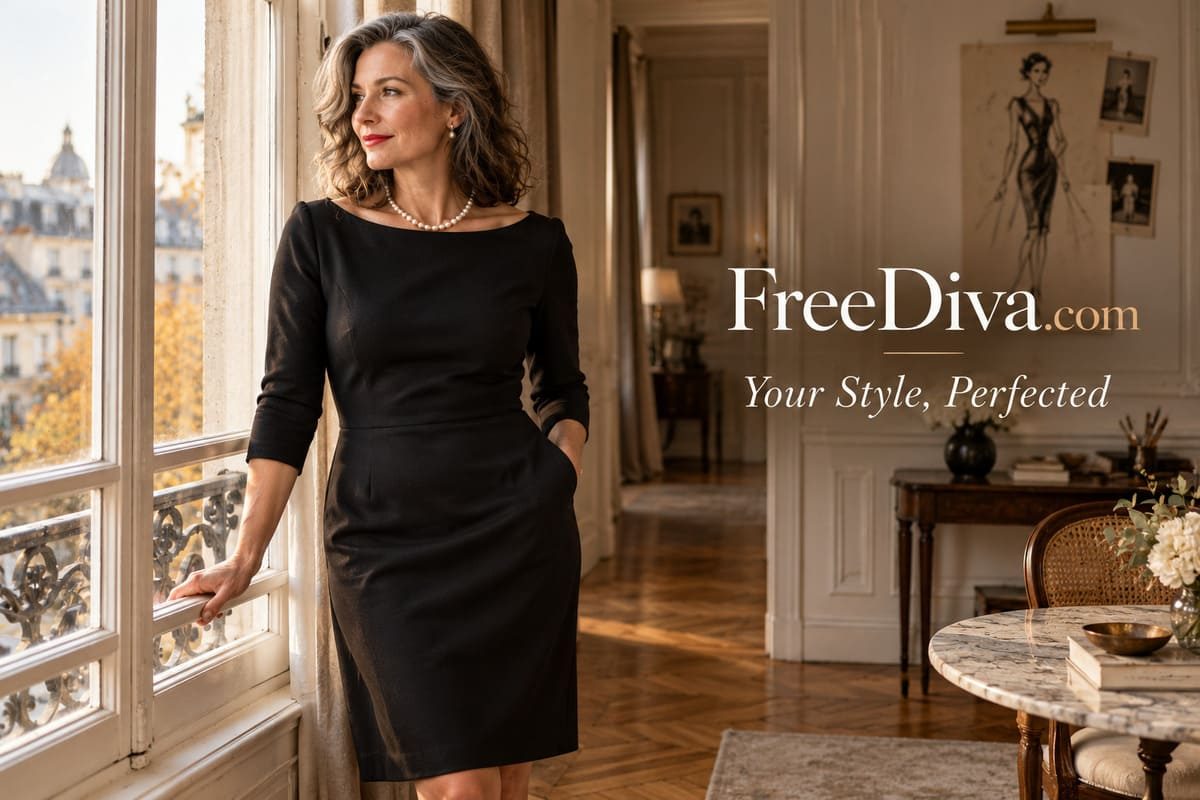
Solid black at the throat can drain a face that has lost some contrast, especially with gray or silver hair. The fix is skin or light near the face, not avoiding black. A wide boat neck, a soft V or a square neck lets skin break up the black and draws the eye to the collarbones, which age better than almost anything. A high crew neck in black works best on women with strong natural contrast (dark hair, bright eyes). If your coloring is softer, our guide to colors that flatter every skin tone explains why.
Pick the length for your knees and your shoes
Just below the knee to mid-calf is the most useful length after 40. It hides the knee, which is the part most of us are happy to skip, and it works with a block heel or a low boot. Above the knee looks sharpest with opaque black tights, which also keep you warm in December. Floor length is for black tie: if the invitation says that, follow it, as our winter wedding guide explains.
Fabric decides whether it looks expensive
This is where cheap black dresses give themselves away. Thin, shiny polyester jersey clings and shows every seam and strap. Skip it. Look for weight and a matte or soft surface: wool crepe, heavy ponte, matte crepe with a lining, or velvet for December. A little structure in the fabric skims the stomach rather than outlining it. If the middle is your concern, a wrap front or ruching at the side does more than any shapewear.
Sleeves are not a compromise
A three-quarter sleeve, or a long sleeve in sheer black chiffon or lace, looks more modern at a party than a sleeveless dress with a cardigan over it. It also solves the cold-venue problem without a coat indoors.
Then add one thing, not five
The black dress is a frame. Chanel's 1926 version came with pearls; Hepburn's with pearls and gloves; the lesson is that the dress carries one strong addition well. Choose one:
- A red lip, the most reliable partner black has. Our guide to finding your perfect red matches the shade to your undertone.
- Big pearls or a single bold earring, which put light right at the face.
- A colored shoe or bag in emerald, burgundy or metallic.
- A velvet or satin jacket over the shoulders for the walk in.
For complete party looks built around these ideas, see our holiday party outfits for 2026 and how to look festive without looking tacky. For midnight on December 31, our New Year's Eve outfits show black can sparkle without a full sequin dress. And if you are rethinking what suits you at this stage more broadly, how to dress in your 50s covers the updates that matter most.
If you are not sure which neckline or shade of black flatters you, upload a photo to the FreeDiva stylist: it reads your body shape and coloring and builds three complete looks around them. Or ask the FreeDiva chat stylist what to wear with the black dress already in your closet. Chanel would approve of using what you own.
Want Personalized Outfit Recommendations?
Upload a photo and let our AI stylist create complete outfits tailored to your body type, skin tone, and personal style.
Try AI Stylist