The Pilgrims did not dress only in black, and they did not wear buckles on their hats. The estate inventories written up when Plymouth colonists died list a violet cloak, a green gown, a red waistcoat, a blue suit, green drawers and a red petticoat, alongside some black for Sundays and serious occasions. The tall buckled hat, the head-to-toe black and the starched white collar on every figure are a picture the 19th century painted, not something the colony recorded.
That matters for more than trivia night. If you have ever felt you had to dress in brown and black for Thanksgiving to look "right," the people the holiday is built around would have found that strange. Their wardrobes ran to violet, murrey, olive and red. Below is what the records say, where the costume came from, and what to borrow for the table on November 26.
What did the Pilgrims actually wear?
The best evidence is not paintings, which are almost all later, but probate inventories. When someone in Plymouth Colony died, neighbors went through the house and listed and valued everything in it, down to the stockings. Pilgrim Hall Museum in Plymouth publishes transcriptions of several. Three of them, read line by line, settle the question.
Mary Ring, died 1631
Mary Ring died in Plymouth in July 1631, and her will and inventory read like a woman's closet. Among her clothes: "1 Red petticote," a violet petticoat, a violet waistcoat, a waistcoat and a petticoat both listed as mingled (mixed) color, "1 murrey apron," "3 blew Aprons," "1 pr blew stockins" and "1 pr white Irish stockins." Murrey is the old word for mulberry color, a dark red sliding toward purple.
She owned black too: "1 black Say kertle" and "1 black Say apron." And she kept cloth in store for making more, in gray, red and blue.
A small correction while we are here: many popular sites say she left "two violet waistcoats" and date her estate to 1633. The museum's transcription lists one violet waistcoat and one violet petticoat, and heads the inventory "deceased 1631." Even the myth-busting has myths.
Elder William Brewster, died 1644
William Brewster was the colony's church elder, the man you would expect to dress most soberly. His 1644 inventory, valued by Captain Myles Standish among others, does include a lot of black: two black coats, a black cloth suit, a black stuff suit, a black suit and cloak, a black hat and black silk stockings. His single most valuable garment was "1 black gowne," at 2 pounds 10 shillings.
But the same list has "1 blew cloth suite," "1 paire of greene drawers," "1 greene wascoate," "1 red capp" and, at his house in Duxbury, "1 violet color cloth coate" worth 1 pound 5 shillings. That violet coat was worth more than his blue suit. The elder of the Plymouth church owned a violet coat, a red cap and green drawers. Hold that image next to the pageant Pilgrim.
Governor William Bradford, died 1657
Bradford was the colony's longtime governor, and his inventory, taken after his death on May 9, 1657, has the most interesting wardrobe of the three. Listed under "his clothes" in the new chamber:
- "a stuffe suite with silver buttons & a Coate" (4 pounds, the priciest outfit on the list)
- "a Turkey Grogorum suite and cloake"
- "a paire of blacke briches and a rid waistcoat"
- "a lead coullered cloth suit with silver buttons"
- "a sad coullered Cloth suite" and "a sad coullered short coate"
- "a light Coullered stuffe Coate" and "a light Cullered Cloth Cloake"
- "an old green goune"
- "an old violett Coullered Cloake"
- "2 hates a blacke one and a coullered one"
Sad here does not mean unhappy: used of color it meant dark or deep. Lead-colored speaks for itself. And in his stores there was olive-colored kersey waiting to be made up. So the governor of Plymouth owned silver buttons, a red waistcoat, a violet cloak, a green gown and a hat in some color other than black. He also owned black breeches and a black coat. Both things are true, and that is the point: black was one color in the closet, not the uniform.
Did the Pilgrims wear black at all?
Yes, and it would be a new myth to pretend otherwise. The World History Encyclopedia's summary of the evidence puts it plainly: the Pilgrims "wore brightly colored clothing most of the time," and their black outfits were worn on the sabbath and on solemn Days of Humiliation. Brewster's black gown being the most valuable thing he wore fits that picture: black was the good outfit, for church and for occasions that called for gravity.
There is a further wrinkle. The General Society of Mayflower Descendants points out in its guide to Pilgrim dress that early 17th-century "black" was not today's flat jet black: very dark grays, greens and blues, and the natural wool of black sheep, could all pass under the name. When an inventory says black, picture something closer to a deep charcoal or ink.
What they did not have were the buckles. Buckles, as the Christian Science Monitor's roundup of Thanksgiving myths notes, were not commonly worn until much later in the 17th century. Shoes closed with straps or laces, and the Mayflower Society's dress guide lists latchet shoes for both men and women.
Where did the black clothes and buckle hats come from?
Three things built the costume, and none of them is a Plymouth record.
The 19th century needed an image. By then the Pilgrims had become a national founding story, and the costume was assembled to fit it. James W. Baker, a former historian at Plimoth Plantation (now Plimoth Patuxet Museums), wrote that in the 19th century buckles were assigned to the Pilgrims because they "served as an emblem of quaintness," the same reason illustrators gave Santa Claus buckles. The buckle was shorthand for "long ago," not evidence of anything. World History Encyclopedia calls the buckled-hat Pilgrim simply "a 19th-century construct."
One portrait. The only Pilgrim whose portrait was painted from life is Edward Winslow, painted in London in 1651, and the picture hangs at Pilgrim Hall. He wears a black doublet with a white collar and cuffs. That is a man in his best clothes sitting for an expensive portrait, which is exactly when you would expect black. It became the template anyway, because it was the only face anyone had.
Mixing up Pilgrims and Puritans. The separatists at Plymouth and the Puritans who later settled Massachusetts Bay were different groups, the Puritans arriving about a decade later, but later retellings blurred them, and the Puritans' reputation for sober dress rubbed off on the Plymouth settlers.
Add generations of school pageants and paper hats, and the costume became more familiar than the record. It is a good reminder for any fashion history you read: the famous image is often the formal one, or the invented one, and the everyday wardrobe was more colorful than anyone remembers.
What colors did the Pilgrims wear? A quick decoder
Put the three inventories together and the palette is strikingly wearable now:
- Violet: a violet cloak (Bradford), a violet coat (Brewster), a violet petticoat and waistcoat (Ring).
- Green: a green gown, green drawers, a green waistcoat, olive kersey.
- Red and murrey: a red petticoat, a red cap, a red waistcoat, a mulberry apron.
- Blue: a blue cloth suit, blue aprons, blue stockings.
- Grays and darks: lead-colored, sad-colored, gray kersey, and black for best.
- Whites: linen caps, ruffs, white stockings, white aprons.
Notice the character of it. These are plant-dyed wools, and the Mayflower Society notes that reds of the period leaned toward brick or madder, more orange than a modern red. Think deep reds, mossy greens and purple-leaning violets, with white linen near the face. It is, give or take a few centuries, a very good autumn palette.
What to borrow for Thanksgiving this year
You are not dressing up as anyone. You are taking a color story that has the best possible excuse at this particular dinner and wearing it the way a grown woman does in 2026.
Make violet the coat or the sweater. Bradford and Brewster both had a violet outer layer, and it is still the smartest way to wear the color: a plum or aubergine wool coat, or a violet fine-gauge sweater, with dark trousers. Violet next to the face flatters most coloring better than straight black, which can drain skin after 40. If you want help choosing the right depth, start with how to wear royal purple and the broader guide to colors that flatter every skin tone.
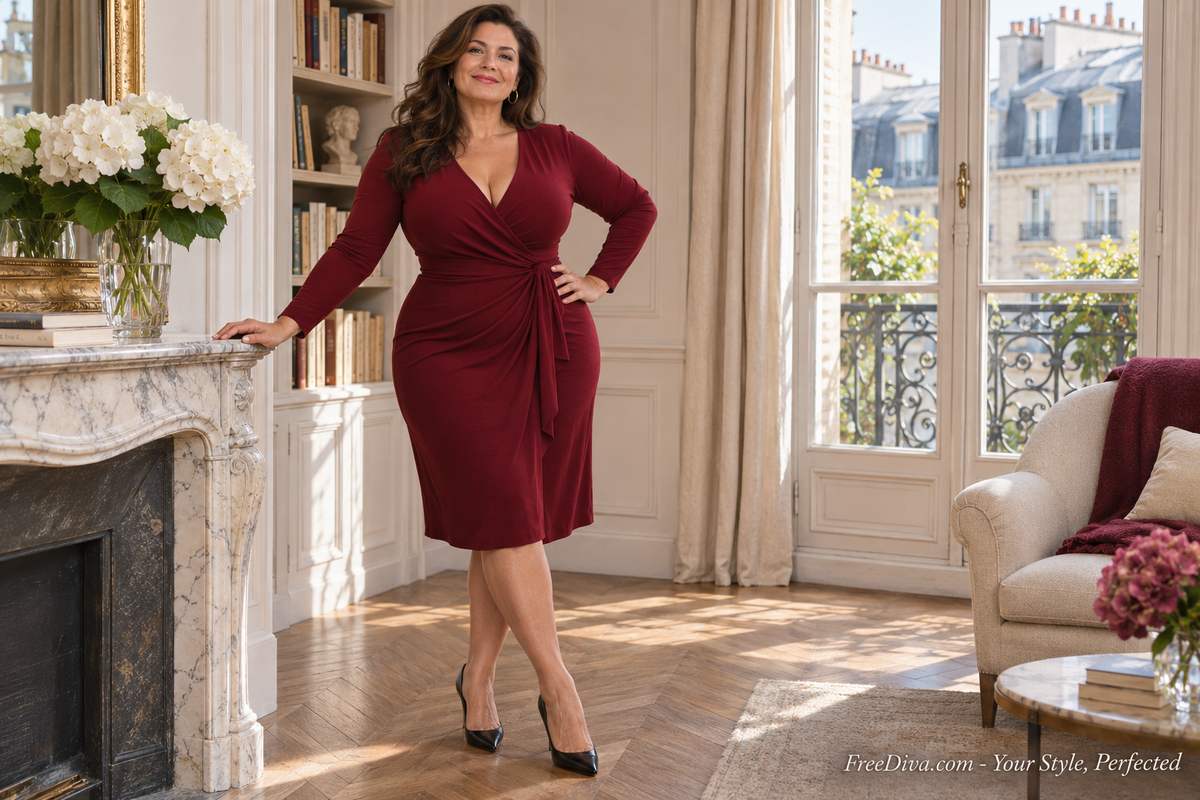
Use murrey as your burgundy. That mulberry apron is the ancestor of the season's favorite red. A wine-colored knit dress or a burgundy blouse under a camel cardigan reads warm and festive without a single novelty print. The full method, including what to pair it with, is in how to wear burgundy.
Wear "sad colors" on purpose. Brown, olive and charcoal are the backbone of the inventories. A chocolate trouser with an olive sweater is rich rather than drab when the textures differ, say a matte wool against a slightly glossy knit. See how to wear brown this fall for combinations that do not go muddy.
Borrow the waistcoat. The vest was everywhere in these lists, on women as well as men. A tailored knit or suiting vest over a white shirt is warm enough for a drafty dining room, leaves your arms free for carving and serving, and looks deliberate. Layer it the way you would any intentional fall outfit.
Keep the white at the collar. Linen at the neck and wrists was the one constant. A crisp white shirt collar showing above a crew-neck sweater gives you the same light near the face, minus the pageant.
Add one quiet luxury. Bradford's best suit had silver buttons. Your version is a single good piece: a cashmere sweater in olive or plum (here is how to buy one that lasts) or a coat with handsome metal buttons. One, not five.
For the whole outfit, by kind of gathering, the Thanksgiving outfits guide covers everything from a formal family dinner to a long weekend at the in-laws', and if your table is friends rather than family, Friendsgiving outfit ideas keeps it relaxed and comfortable for a long evening on the sofa.
And if you are not sure whether violet or olive is your color, upload a photo to the FreeDiva stylist: it reads your coloring and builds a full look around the shades that suit you, which is more than Governor Bradford ever got from his tailor.
Want Personalized Outfit Recommendations?
Upload a photo and let our AI stylist create complete outfits tailored to your body type, skin tone, and personal style.
Try AI Stylist