The cardigan is named after James Brudenell, 7th Earl of Cardigan, the British cavalry officer who led the Charge of the Light Brigade at Balaclava in October 1854. A knitted, buttoned woolen jacket became fashionable under his name in the years after the Crimean War, and the word has stuck to every front-opening knit since. From there it moved through Chanel's jersey suits, the 1950s twinset, Mister Rogers' television set and Kurt Cobain's 1993 Unplugged stage, which is why one garment can read soldier, socialite, grandfather or grunge depending on how you wear it.
Below is the short, checked version of that story, and then the part that matters on a Tuesday morning: how to wear a cardigan after 40 so it looks chosen, not defaulted to.
Why is it called a cardigan?
The earl is real, the battle is real, and the link between them and the sweater is looser than the legend. Etymonline dates "cardigan" as the name of a knitted woolen jacket to 1868, the year Brudenell died, and says he set the style, adding that in one account he wore such a jacket while leading the charge. Michael Quinion's World Wide Words finds earlier references, from 1857, to "cardigan jackets" and later "cardigan waistcoats", and is blunt that he did not invent the garment, whatever some writers claim.
So the honest version runs like this. Knitted wool jackets and waistcoats already existed. The Crimean winter of 1854-55 was brutal, the charge made Cardigan briefly the most famous soldier in Britain, and sellers did what sellers still do: they put a celebrity's name on a product. The early cardigan was close-fitting, collarless and often sleeveless, closer to a knitted vest worn under a uniform coat than to the slouchy thing in your drawer.
Whether he actually wore one into the Valley of Death is not something the record settles. Treat it the way you would treat a brand's founding story: plausible, flattering and repeated more than it was ever checked.
Two other words from the same war followed the same route: the raglan sleeve and the balaclava, named for Lord Raglan, the British commander, and for the battle itself. Crimea dressed the next century more thoroughly than it settled anything.
1916: Chanel turns it into women's clothing
For its first sixty years the cardigan was mostly a men's sporting and working layer. Gabrielle Chanel changed its audience. The Kyoto Costume Institute, describing a Chanel day ensemble from about 1928 on Google Arts & Culture, says she introduced cardigan suits in 1916, in jersey, a fabric that until then had mostly been used for underwear, and that women who wanted to move liked them for exactly that reason.
The jacket of those early Chanel suits was, in effect, a cardigan: soft, unlined, buttoned down the front, no structure fighting the body. The Metropolitan Museum of Art catalogs a Chanel ensemble and traces the line directly, noting that her 1920s collections paired a skirt with a wool jersey cardigan as the jacket, and that this is the ancestor of what we now call the Chanel suit. The gilt buttons and braid came much later.
That is the first useful lesson for a grown-up wardrobe. The most famous "polished" jacket in fashion started as a sweater. A good cardigan, worn with intent, is allowed to do a jacket's job. If you want the companion piece on how a single garment became shorthand for dressing well, read the true history of the little black dress, which runs through the same Chanel years.
The 1930s to 1950s: the twinset and the sweater set
The next turning point came from Scotland. The V&A records that Pringle of Scotland's Austrian-born designer Otto Weisz has been credited with introducing the twinset in the 1930s: a short-sleeved knit top and a matching cardigan in the same yarn and color. The Scotsman's history of Pringle at 200 puts the date at 1934.
By the 1950s the set was everywhere, usually in pastel cashmere or lambswool, worn with a string of pearls, a full or pencil skirt and, often, the cardigan draped over the shoulders rather than worn with arms in the sleeves. In America it was the uniform of the college girl and the suburban mother at once.
This is also where the cardigan picked up the baggage that makes women over 40 nervous of it. The twinset meant respectable, careful, ladylike, and by the 1970s it meant your mother. The pieces themselves were not the problem. The full matched set, plus pearls, plus a sensible skirt, all in one pastel, is a costume of a decade. Break up any one of those and it turns modern again.
1968 to 2001: Mister Rogers zips up
For American viewers, the cardigan has one face. Fred Rogers changed out of his sport coat and into a cardigan at the start of every episode of Mister Rogers' Neighborhood, from 1968 until 2001. According to the Smithsonian, he gave one of them, a red knit cardigan, to the National Museum of American History in 1984; the Smithsonian Institution Archives dates the handover to November 20 of that year. The museum's cultural historian Dwight Bowers told the magazine that Rogers' "style of comfort and warmth, of one-on-one conversation, is conveyed in that sweater."
Most of the sweaters he wore on the show were hand-knitted by his mother, Nancy McFeely Rogers, and he moved from buttons to zippers early on to make the on-camera change quicker, as CNN reported on the show's history.
What Rogers understood, and costume designers since have borrowed, is that a cardigan signals that you have arrived and are staying. A blazer says business. A cardigan says sit down. Worth knowing when you choose one for a meeting.
1993: Kurt Cobain makes it rebellious
Twenty-five years into Mister Rogers, the cardigan got a second, opposite meaning. Kurt Cobain wore a worn olive-green cardigan for Nirvana's MTV Unplugged set in New York in 1993, a few months before his death in April 1994. In October 2019 that same sweater, never washed, sold at Julien's Auctions for $334,000, which the auction house called the most expensive sweater ever sold at auction.
Grunge took the cardigan back from the twinset. Oversized, a little shabby, thrown over a T-shirt, it read as indifference to being looked at, which of course is its own kind of style.
Now: the grandpa cardigan and the cardigan as a top
Both strands are alive today. The chunky cable "grandpa" cardigan, oversized with a shawl collar or deep V and big buttons, came back hard around 2020, helped along when Taylor Swift released a song called "cardigan" and then sold a cream cable-knit cardigan as album merchandise.
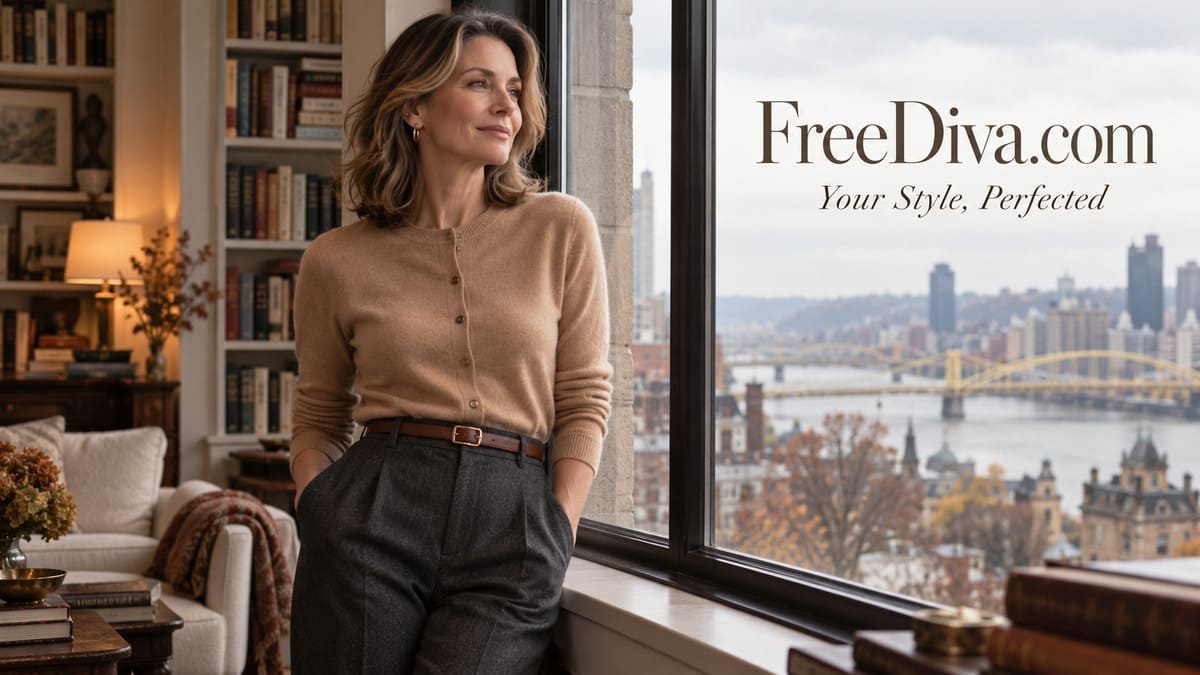
The other strand is quieter and more useful: the fine-gauge cardigan buttoned up and worn alone as a top, tucked into trousers or a skirt. It is the twinset with the shell removed, and it is one of the best pieces a woman over 40 can own, because it gives the neckline of a blouse with the softness of a sweater.
How to wear a cardigan after 40 without looking frumpy
Frumpy is almost never the cardigan. It is the cardigan's length, weight or company. Here is what decides it.
1. Match the length to where you want the eye to stop
A cardigan draws a horizontal line where it ends, and the eye lands there.
- Cropped, ending at the natural waist: best over high-waisted trousers or a midi skirt. It shows your waist even when the cardigan is open. Ideal if you are petite or short-waisted.
- Hip length, ending at the top of the hip bone: the safe all-rounder. It works with straight jeans and most trousers. If your hips are your widest point, end it either above them or below them, never right at them.
- Long, ending mid-thigh or lower: worn open, it makes two long vertical lines down the front, which lengthens and narrows. It needs a slim, unbroken line underneath: one color top and bottom, straight trousers, a column of knit. Over wide pants and a flowing top it becomes a dressing gown.
If you carry weight through the middle, the long open cardigan over a single color is your friend; the apple-shape guide explains why the vertical line beats a cinched waist for some bodies. And for the trousers underneath, the right rise and fabric for a tummy matters as much as the knit.
2. Button it and wear it as a top
Take a fine merino, cotton or cashmere cardigan, button every button, and tuck the front into trousers or a skirt. With a V-neck it reads like a silk blouse that will not crease in the car; with a crew neck it reads ladylike in the right way.
Two rules. The knit has to be fine enough not to bunch at the waistband, so skip chunky yarns here. And buttons should lie flat with no pulling across the bust; if they gape, size up and have the sleeves shortened rather than living with the pull. Add a belt, small gold earrings and loafers or a low boot, and it is office-ready.
3. Belt it
A belt over a cardigan turns a shapeless layer into a wrap jacket. This works best with a mid-weight knit that falls to the hip or just below. Use a slim to medium belt in leather or suede, worn at your natural waist or slightly above, and leave the cardigan open at the neck so there is a V above the belt.
Skip it with very thick knits, which puff above and below, and with long dusters, which turn into a bathrobe with a belt.
4. Wear it over a dress, and choose the right one
A cardigan over a dress is a classic for a reason, but most women get the length wrong. With a midi or knee-length dress, the cardigan should end at or just above the waist, or be long enough to almost meet the hem. The middle ground, ending at the hip, cuts the dress into two awkward halves.
For a slip dress, a cropped cardigan buttoned only at the top is the modern version of the twinset, and works from fall into a mild winter with boots. Over a knit dress, go long and open. Over a dress you would wear to a wedding, a dressier knit in silk-blend or fine cashmere in the same color family as the dress beats a contrasting color every time.
5. Decide on fabric before style
The fabric is what separates the quiet-luxury cardigan from the one that pills and sags by February.
- Fine merino: the workhorse. Warm, breathable, thin enough to tuck.
- Cashmere: the softest drape and the most forgiving to wear as a top. Ply and yarn length matter more than the label; how to buy a cashmere sweater that lasts covers what to check before paying.
- Cotton: good for spring and warm offices, but it stretches out. Buy it slightly snug.
- Chunky wool or alpaca: this is your grandpa cardigan. Wear it as an outer layer over a slim base, not as a top.
- Acrylic-heavy blends: they pill quickly and they look shiny under office lights. Avoid anything that is mostly acrylic, whatever the price.
6. Break up the set
If you love the twinset, keep the shell and the cardigan in the same yarn but wear them with something that belongs to now: dark straight jeans, wide-leg wool trousers, a leather skirt, a chunky loafer. Lose the pearls or swap them for a single heavy chain. One period reference per outfit is charm; three is costume.
A cardigan for every kind of day
For cold days, the long cardigan works as a coat inside and as a middle layer under one outside; fall layering that looks intentional shows how to keep the layers from piling up, and cozy without frumpy goes further into texture and proportion. If you are in a decade where everything suddenly reads dated, how to dress in your 50s explains which details age an outfit, and a cardigan is often the easiest fix on that list. For the office, the buttoned-up fine-knit cardigan sits comfortably inside a business casual dress code, as our dress codes guide sets out.
The cardigan has been a soldier's layer, a couture jacket, a ladylike set, a children's TV uniform and a rock star's armor. It is flexible enough to be whatever you need it to be, which is exactly why the length and fabric have to be your decision, not the store's.
If you are not sure which length and weight will work on your frame, upload a photo to the FreeDiva stylist and it will read your body shape and coloring and build looks around a cardigan that suits you. Or ask the FreeDiva chat stylist what to wear with the one already in your closet.
Want Personalized Outfit Recommendations?
Upload a photo and let our AI stylist create complete outfits tailored to your body type, skin tone, and personal style.
Try AI Stylist