The best pants for a tummy are high or mid-high rise (sitting at or just above the navel, not below the belly), flat-fronted, with a wide, smooth waistband and a fabric heavy enough to hang rather than cling: crepe, ponte, wool blends, rigid or low-stretch denim. Leg shape comes second. A wide or straight leg that falls cleanly from the fullest point of the hip balances a round middle; a skinny leg on stretchy fabric makes it the focus. And the only test that counts is sitting down.
That is the short version. The longer one is worth having, because "pants for a tummy" is not one problem. A soft lower belly, a high round middle, a waist that has thickened after 45 with hips that have not: each wants a slightly different pair. If your body has changed recently, this piece on how bodies change after 35 explains the shifts; here we deal with the pants.
Start with the rise, because everything else sits on it
Rise is the distance from the crotch seam to the top of the waistband. It decides where the band lands on your body, and the band is where pants either work or fight you.
The mistake most of us made in the 2000s was the low rise: a band that sits under the belly pushes softness up and over it. A rise that crosses the fullest part of the tummy does the same thing, only higher. What you want is a band that sits above the fullest point, or at least at a part of you that does not move much when you sit.
How high depends on your torso. Madeline Manning, lead stylist at the Watson Style Group, put it simply to TODAY: if you are long-waisted, go for a higher rise at the natural waist; if you are short-waisted, a mid-rise suits you better. A short-waisted woman in an 11-inch rise often ends up with a band pressing into her ribs and folding over when she sits. Manning pairs the higher rise with a 1- to 2-inch waistband, and a narrower half-inch to 1-inch band for shorter waists.
A rough guide, measuring the front rise of a pair you already love against the label of a pair you are considering:
- Front rise of 9.5 to 10.5 inches: mid-high, the safest place to start.
- 11 inches and up: true high rise, best if you have a long torso.
- Under 9 inches: low. Skip it for this purpose.
The waistband is the real support, not the panel
Most "tummy control" claims live inside the waistband, and they vary a lot. Here is what to look for, in order of usefulness.
A wide, flat, interfaced band. Something firm, about 1.5 to 2 inches wide, spreads pressure across your middle instead of concentrating it in one line. Stylist Sandra Okerulu told TODAY to look for a band that distributes compression evenly, so it does not dig. A thin, soft band rolls; a thick, firm one stays put.
A contoured waistband. The band is cut in a gentle curve rather than a straight strip, so it follows the shape of a body that is not a cylinder. Better trousers do this. You can see it when the pants are laid flat: the band arcs, it does not run straight. A good-fitting band is not even parallel to the floor; Threads magazine, the sewing and fitting journal, notes it usually dips 1/4 to 1/2 inch lower in front, which is exactly where a tummy needs the room.
Flat front, elastic back. A smooth front with a stretch section only across the back gives you the clean line of a tailored trouser and room to breathe at dinner. It is one of the best compromises in ready-to-wear, and plenty of mid-range brands make one.
Side zip or fly. A side zip leaves the front completely flat, with no fly shield or button to add a layer right on the belly. It suits a tummy beautifully, provided it is a quality invisible zip. A fly front is fine if the fly lies flat; if the zip pulls into a curve or the button tab tilts down when you stand, the pants are too small in the front rise, not your fault.
What to treat with suspicion: a narrow band of gathered elastic all the way round (it bunches and shows under a top), heavy front panels in thin fabric (they flatten the belly and push the softness to the sides), and drawstrings in a bulky fabric.
Fabric weight matters more than stretch
Here is the part most guides get backwards. More stretch does not mean more flattering. Very stretchy, lightweight fabric shows every curve under it; heavier fabric with a little stretch drapes over you and moves when you move.
Okerulu's numbers are useful: for everyday pants, a cotton blend with 2 to 5% elastane; for denim, 1 to 4%. Manning calls crepe one of the most underrated fabrics for a tummy, and both point to ponte knit for a dressier option. Ponte is a double knit, thick and stable, so it smooths without the sausage-casing effect of leggings.
The fabrics that work, roughly from dressiest down: wool crepe and wool blends, polyester crepe with weight, ponte, cotton twill, rigid or low-stretch denim, heavy linen blends in summer.
The ones to skip for a fitted pant: thin jersey, lightweight satin, anything shiny that catches light on curves, and denim with 3% or more stretch if you want it to keep its shape. High-stretch jeans relax as you wear them; the pair that feels perfect at 10 am is baggy in the seat by lunchtime. More on that in our guide to finding jeans that actually fit.
Pleats, pockets and the details on the front
Pleats. The rule you will read everywhere is "avoid pleats." It is half right. Deep double pleats in a stiff fabric add volume exactly where you do not want it. But a single, soft pleat in a fluid fabric can give a tummy room and let the leg fall straight. The test is simple: stand in front of the mirror. If the pleats lie closed, they are working. If they splay open, the pants are too tight across the hip and front, and no size of pleat will fix it. Size up or move on.
Pockets. Slanted front pockets that gape are the most common problem on a fuller middle: they open into little wings at the hip. Look for pockets that are sewn flat or set into the side seam. Patch pockets on the front of the thigh are fine; patch pockets right on the belly area, such as cargo styles, are not. On the back, a pocket placed on the seat, not too low and not too small, keeps the proportion balanced.
Belt loops. Not essential. Belting tight at the fullest part of the tummy cuts you in two. A slim belt worn loosely at the natural waist, or no belt, works better.
What to test in the fitting room
Bring the shoes you will wear with the pants, and the kind of top. Then run through this, in order. It takes three minutes.
- Stand and look at the front. The fly or front seam should hang straight, without pulling into a smile shape. Pleats closed. Pockets flat.
- The two-finger test. Slide two fingers flat between the waistband and your skin. If they do not fit, the waistband is too small. If your whole hand fits, it will gap at the back. Two fingers with a little resistance is right.
- Sit down, properly. On a bench, for a minute, as you would at a desk or a restaurant. Does the band dig in? Does it fold over at the top? Does the front rise bunch up into a ledge? If the band digs only when seated, the rise is wrong for your shape: try a higher or lower rise rather than a bigger size.
- Bend over as if to pick up a bag. The back should not gap, and you should not be pulling the pants up afterward.
- Look at the side view. The leg should fall cleanly from the fullest point of the hip, without cupping under the seat.
- Walk to the end of the fitting room and back. If you already want to tug at the waistband after ten steps, you will be tugging at it all day.
Then think about the top. Pants for a tummy look best with a top that ends just below the hip bone, or with a loose front tuck that shows the waistband in front without needing to hold it there. For a broader view of balancing a round middle, see our guide to defining your waist with an apple shape.
The shapes to try first
Four shapes, roughly in the order I would bring them into the fitting room.
1. Wide-leg trousers in a heavy crepe or wool
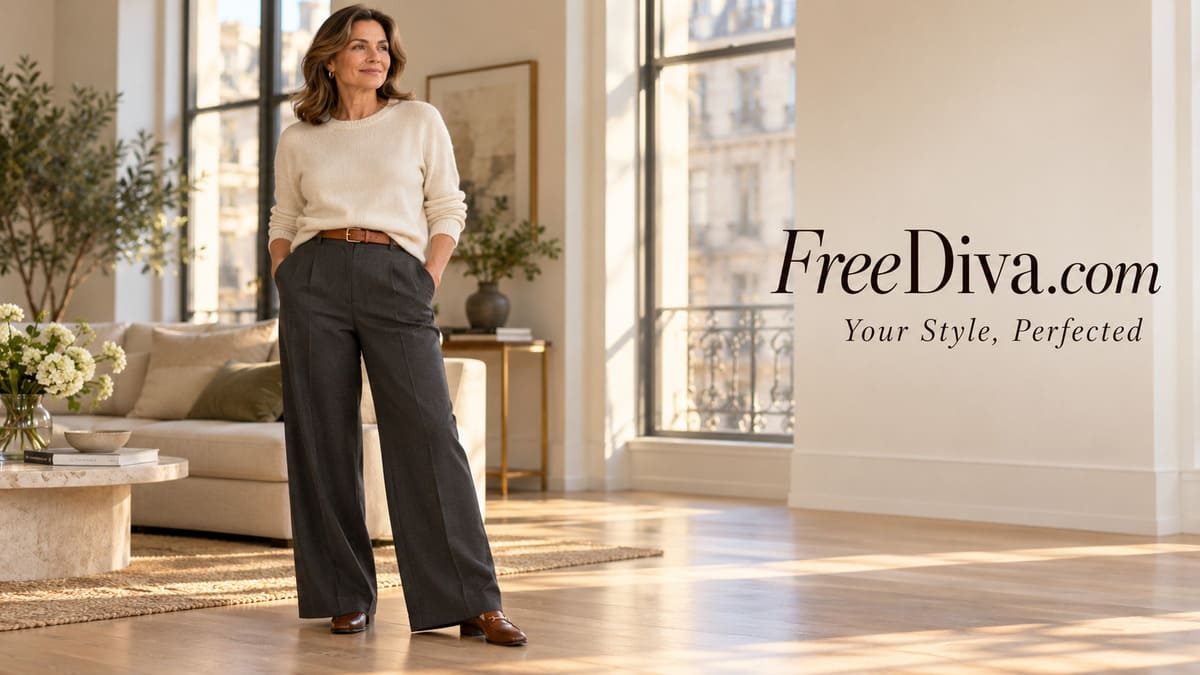
The first pair to try, and the most forgiving. A wide leg that falls from the hip in a straight line gives your lower half a strong, simple shape, so the midsection reads as one part of a long vertical line rather than the focal point. Sylvia de Vries of 40+Style makes the same point: wide-leg pants work well when you have a belly, and if you go cropped, choose a high waist. Pick a full length that grazes the top of the shoe. Charcoal, navy, chocolate and camel in crepe are the useful colors; wear with a fine knit or a silk shell.
2. Straight-leg pants with a contoured waistband
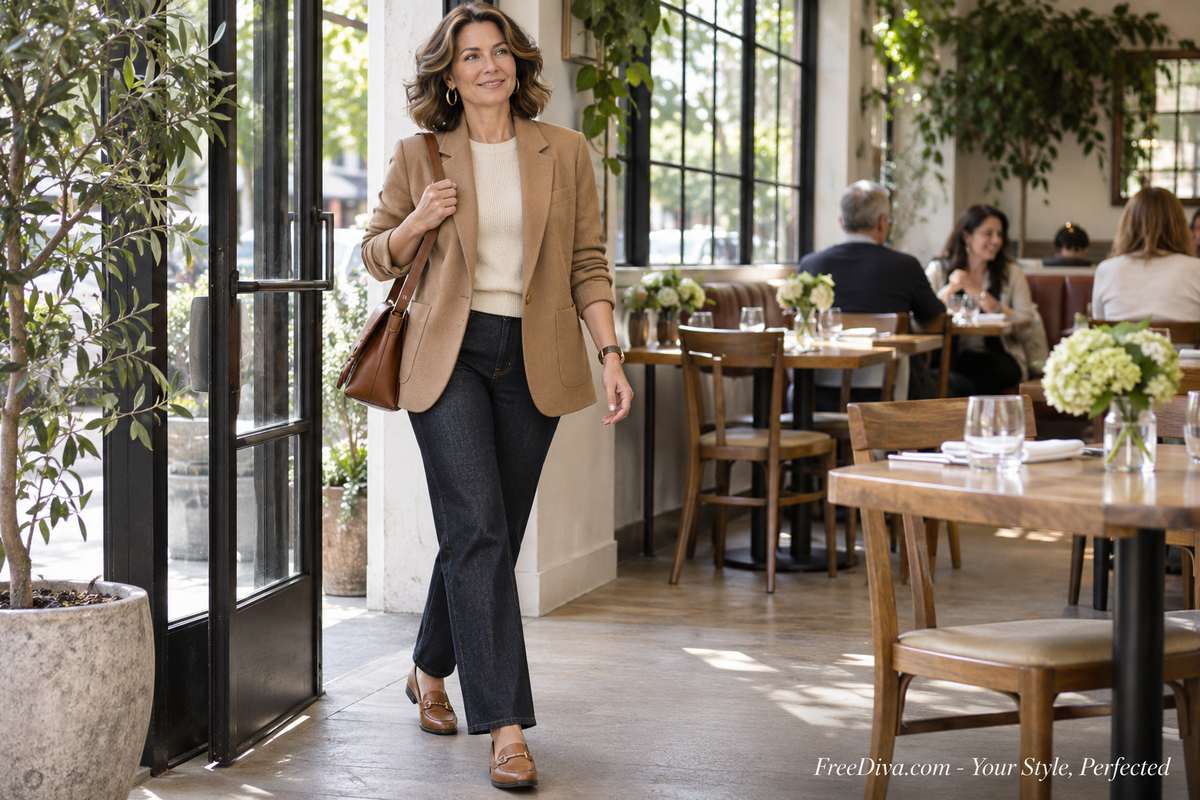
The everyday workhorse. A straight leg from hip to ankle in a mid-weight twill or wool blend, mid-high rise, flat front, side zip or flat fly. The leg should be just wide enough at the knee that it does not narrow toward the ankle: a straight leg that tapers turns into a peg shape and draws the eye up to the widest part. This is the pant that goes under a blazer for work; our workwear capsule builds a week around it.
3. Trouser jeans in rigid or low-stretch denim
Trouser jeans are cut like tailored pants, with a higher rise, a wide or straight leg and often a front crease, but in denim. They are a better choice for a tummy than skinny jeans because the fabric is heavier and the leg is generous, so nothing clings. Look for 1 to 2% elastane, a waistband at least an inch and a half wide, and back pockets of a decent size. Dark indigo with a white shirt or a navy sweater is a reliable weekend outfit.
4. Pull-on ponte pants with a wide flat band
The answer for long travel days, long workdays and anyone who simply hates zips. The difference between good and bad pull-ons is the waistband: a wide, flat band in the same ponte as the pant, not a strip of gathered elastic. Straight leg rather than leggings-tight. In black or navy with a tunic-length sweater, they pass for trousers.
What to skip, and why
- Low rise of any kind. The band lands below the belly and pushes it up.
- Skinny jeans in high-stretch denim. They cling under the tummy and narrow at the ankle, which makes the middle look wider by contrast.
- Paperbag waists and big tie belts. Extra fabric gathered right at the midsection.
- Very shiny fabrics in a fitted cut. Light catches every curve. Save satin for a fluid wide leg.
- Front patch or cargo pockets at hip level. Volume where you least want it.
- Joggers with a cuffed ankle. Fine for the sofa, but the narrow cuff makes the top half look heavier.
None of these are rules carved in stone, and some women wear a paperbag waist beautifully. As we argued in why body type rules are meant to be broken, the goal is the pair you forget you are wearing. If you are in your fifties and want to see where these pants fit into a modern wardrobe, our guide to dressing in your 50s covers what to update first, and the complete body type guide takes you through the rest of the outfit.
And if you would rather not guess your proportions, upload a photo to the FreeDiva stylist. It measures your shoulders, waist and hips from one picture and builds outfits around your actual shape, pants included.
Want Personalized Outfit Recommendations?
Upload a photo and let our AI stylist create complete outfits tailored to your body type, skin tone, and personal style.
Try AI Stylist