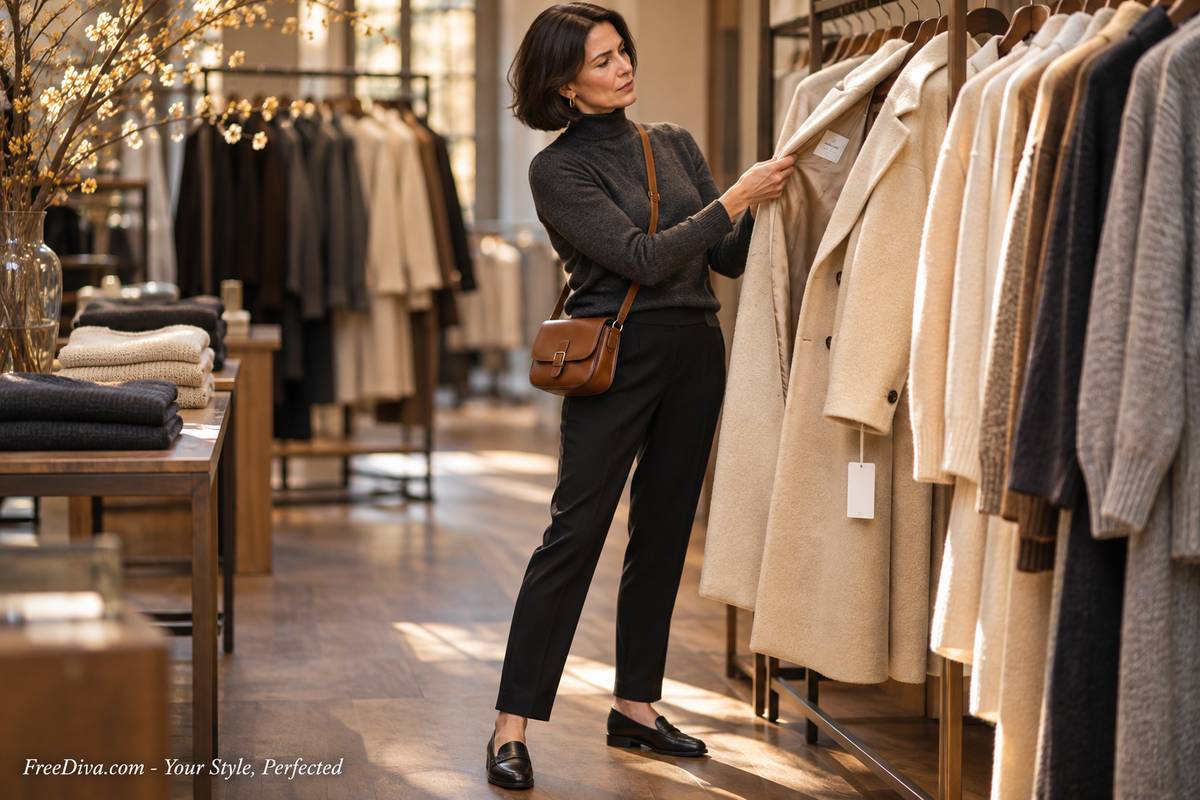
A real clothing deal is a price that is lower than what the piece actually sold for, on something you would have bought anyway, in a fabric that justifies the money. A fake discount is a cut from a "compare at" or "original" price the item rarely or never sold at. You can tell them apart in about five minutes: check the price history, read the fiber label, work out the cost per wear, and find the return policy before you pay.
Black Friday 2026 is Friday, November 27, and the percentage on the sign is the least reliable number in the store. Here is how to check the others.
What does "compare at" actually mean?
Often, nothing you can verify. The California Attorney General's office puts it bluntly in its consumer guide to outlet stores: with a "compare at" price, "the item might have never actually been sold at a retail store or at that higher price," and "the ticketed price could be made up." The same page points out that most outlets now sell "products made or bought specifically for the outlet," not last season's mainline stock. So the cardigan with a $128 "compare at" tag may be a different, thinner cardigan from the one in the brand's full-price store.
"Original," "regular" and "was" sound more solid, but they are only as honest as the store using them.
What the FTC's pricing rules actually say
The Federal Trade Commission's Guides Against Deceptive Pricing, 16 CFR Part 233, have been on the books since the 1960s, and section 233.1 deals with exactly this. The short version:
- A former price is fair to compare against only if it is "the actual, bona fide price at which the article was offered to the public on a regular basis for a reasonably substantial period of time."
- The store does not have to prove it sold many at that price, but it must have "openly and actively" offered the item at that price, in good faith, in the regular course of business.
- A price that was set high for a short time just so a later "cut" looks big is, in the Guides' word, "fictitious."
- A reduction so small it is "insignificant" should not be advertised as a sale at all.
Two things to know about that. First, the Guides do not set a number of days; "reasonably substantial" is left to judgment. Second, they are the FTC's guidance on what counts as deceptive, and in practice much of the recent pressure on fake reference prices has come from state law and from shoppers suing.
California is the state with a number. Its false advertising law says a store cannot advertise a former price unless it was the prevailing price within the three months before the ad, or the ad says clearly when that price was in effect. That rule sat behind the December 2016 suits the Los Angeles City Attorney filed against Macy's, Kohl's, JCPenney and Sears, which, as NBC News reported, cited examples like cargo shorts sold at $35.99 against an "original" $60.
The court case worth knowing is Hinojos v. Kohl's, decided by the Ninth Circuit in 2013. A shopper said he bought items because they were marked down from "original" prices Kohl's rarely charged. The lower court threw the case out on the theory that he got what he paid for. The appeals court disagreed: a shopper who would not have bought without the false former price has lost money, because the bargain itself is part of what he was sold. Outlet pricing has drawn its own suits; Consumer Reports covered several in 2016, including a $4.8 million settlement pool from Michael Kors, which denied wrongdoing, over outlet tags said to overstate markdowns between 2010 and 2014.
None of this means a store is breaking a rule every time a tag says 60 percent off. It means the "before" number is a claim, and you are allowed to check it.
Step 1: Check the price history, not the percentage
Ignore the discount. Ask one question: what has this exact item cost over the last few months?
- Start watching early. The easiest price history is your own. If you already know which coat or boots you want, save the product page in October and note the price on your phone each week. By Thanksgiving you know whether $189 is a cut or the usual.
- Use a browser's price tracking. Google added a shopping panel to Chrome in November 2023 that, on supported store pages, shows an item's typical price and its price history over recent months, with an option to track it. Where it appears, it is the fastest check there is.
- Compare the exact item elsewhere. Search the style name or number, not the description. If three department stores carry the same knit at the same "sale" price all fall, the sale price is the price.
- Notice the permanent sale. A brand that is "40 percent off" most weekends of the year has a real price, and it is the 40-percent-off one. Pay it on a quiet Tuesday, not in a Friday crowd.
A real deal usually looks like this: an item that sat at one price for months, now noticeably lower, on a day the rest of the market is lower too.
Step 2: Read the label before the tag
The fiber label is the one piece of information on a garment that the law requires to be specific. The FTC's guide to the Textile and Wool Acts says fibers must be listed by generic name and percentage by weight, from largest to smallest; anything under 5 percent can be lumped as "other fiber," except wool, which must be named, and a fiber with a real job, like spandex for stretch.
That label tells you what the markdown cannot.
- A wool coat at 80 percent wool and a "wool-blend" coat at 20 percent wool and 80 percent polyester look the same on the hanger. They do not feel the same at a bus stop in January. If the word "wool" is in the name and the number is under 50, the price should be a polyester price.
- Cashmere is the category where a big discount hides the most. A 2-ply, densely knit sweater and a loose 1-ply one both say "100% cashmere." Before you buy any, read how to check a cashmere sweater for the stretch test and the pilling signs.
- Knits in general: hold the piece up to the store light. If you can read the light through it, it will thin at the elbows and pill under a crossbody strap.
- Construction: seams that pull apart under a gentle tug, a hem that is glued or overlocked with no allowance, plastic buttons sewn on with one loose thread. A coat with a full lining, real buttonholes and a spare button in a little bag was made to be kept.
If the fabric is the same as a cheaper brand's, the discount is on the logo, not the garment.
Step 3: Do the cost-per-wear math
Cost per wear is price divided by the number of times you will realistically wear the piece. It is the only discount math that matters.
A $240 wool coat you wear three days a week for four winters, roughly 15 weeks a season, comes to about 180 wears: around $1.33 a wear. A $59 sequin top marked down from $148 that you wear twice over the holidays is $29.50 a wear. The top is the "bigger" deal by percentage and the worse one by a mile.
This is why the pieces worth buying on sale are the ones that are expensive at full price and worn constantly: the coat, the leather boots, the good knit, the trousers that fit. The editors' list of investment pieces worth the splurge is a sound shopping list for exactly this weekend. And for the category-by-category view of what usually is and is not discounted, see what is worth buying in fashion on Black Friday.
One honest test: would you buy it at the full price if you had the money? If the answer is no, the discount is doing the wanting for you.
Step 4: Find the return policy before you fall in love
The most expensive word on Black Friday is "final." A $70 dress you cannot return and will not wear costs $70. A $110 dress you can send back costs nothing if it does not work.
- Final sale is common on deep markdowns, outlet stock and "extra off clearance" codes. It is often in small type on the product page, in the cart or on the receipt, not on the tag. Look before you pay, and ask at the register if you are in a store.
- Holiday return windows are often extended for gifts but can be shorter, or store credit only, for sale items. Read which applies to you.
- Return shipping and restocking fees can eat a modest discount. A 25 percent markdown with a paid return label is not 25 percent if the size is wrong.
- Online, try on within a day and keep tags and packaging until you are sure.
If an item is final sale, it needs to pass a higher bar: the exact size you already own in that brand, a fabric you know, a color you wear.
Step 5: When a coupon on full price beats the sale
Sometimes the better deal is not on the sale rack at all.
Many stores' percentage-off codes exclude items already marked down, so the 30 percent code you got by email works only on full-price pieces. If the thing you actually want is a core item that rarely goes on sale, a navy wool blazer, the black ankle boot in your size, a code on its real full price is a genuine saving on something you would buy anyway. That beats a "60 percent off" tag on a sale-only version in a color you do not wear.
The same goes for loyalty rewards, a birthday code or a price adjustment. Some stores will refund the difference if an item you bought drops in price within a set window; ask, and keep the receipt.
And remember the outlet point from the start: the sale version and the full-price version are not always the same garment. A coupon on the mainline piece can be the better buy even when the outlet price is lower.
The 5-minute deal check
Run this on your phone, in the aisle or the cart, before anything over $50:
- Price history. What did this exact item cost in October? Check your notes, your browser's price panel, or one other retailer.
- Ignore the "compare at." Is the sale price low for the fabric and the category, judged on its own?
- Fiber label. Read the percentages. Wool, cashmere or cotton should be the first fiber listed if it is in the name.
- Construction. Light through the knit, seams, lining, buttons.
- Cost per wear. How many times this year, honestly? Divide.
- Closet test. Name three things you own that it goes with.
- Returns. Final sale? Window? Who pays shipping?
- Coupon check. Would a code on the full-price version cost about the same?
If it fails two of these, put it back. Nothing on Black Friday is the last chance it pretends to be.
A few habits that save more than any markdown
Make the list before the day: the two or three pieces that would change your winter, with sizes. If you are working toward a smaller, better wardrobe, the list is the gaps in it, not a new direction. Boots are a classic list item, and these winter boots that handle snow and rain are a good place to start.
If you are going in person, dress for the fitting room so you actually try things on rather than guessing; the full outfit is in what to wear Black Friday shopping. And if you are curious why the day carries such a grim name in the first place, it was Philadelphia's police, not the accountants: here is why it is called Black Friday.
Before you pay for the coat, ask the FreeDiva chat stylist whether it works with what you already own. Or upload a photo to the FreeDiva stylist, and it will read your shape and coloring and tell you which pieces are worth hunting for this weekend, so the only discounts you chase are on things you will wear.
Want Personalized Outfit Recommendations?
Upload a photo and let our AI stylist create complete outfits tailored to your body type, skin tone, and personal style.
Try AI Stylist