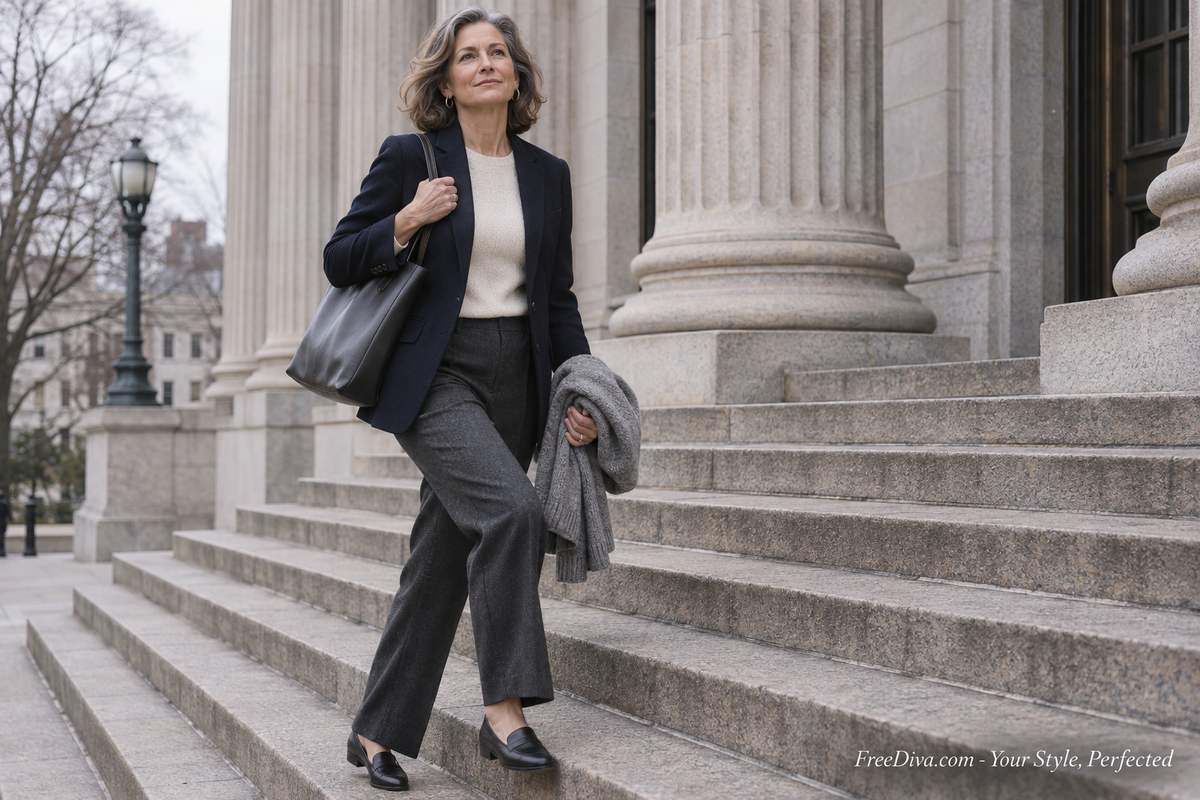
Wear to court what you would wear to a job interview at a conservative office: clean, pressed, business-like clothing that covers your shoulders, midriff and thighs, with closed shoes and very little jewelry. Courts across the US rule out the same short list: shorts, tank tops, crop tops, see-through clothing, beach or athletic wear, and shirts with slogans. Bring a layer, because courthouses are cold, and leave anything sharp at home, because security will take it.
In dress code terms that is business casual at the conservative end, a step above smart casual (the dress code guide has the whole ladder). That applies whether you are a juror, a witness, a party to a case or just there to support someone. The details shift a little by role, and every court sets its own rules, so check your summons or the court's website. But no judge has ever sent someone home for looking too neat.
What do courts actually say about dress?
Courts publish their dress rules, and they are short and surprisingly consistent. A few examples, in the courts' own words:
- The US District Court for the Northern District of Iowa asks jurors "to dress in a manner that is respectful to the litigants and the court" and says "Shorts, jeans, t-shirts, tank tops and sweatshirts should not be worn."
- The Maryland Judiciary says there is "no formal dress code" but jurors must dress for the seriousness of the proceedings, in "clothing that is neat, clean, comfortable and not revealing," and lists hats (except for religious reasons), see-through clothing and employer badges as not acceptable.
- The San Bernardino County Superior Court in California allows "business or casual dress (jeans are allowed)" but says "Shorts, tank tops, crop tops and bare feet are not permitted," and warns that a judge who finds your clothing inappropriate can send you home to change or tell you to come back another day.
- North Carolina's court system, as quoted by the UNC School of Government, advises: "Dress for court as if you were going to work or to church."
Notice the disagreement over jeans. A federal court in Iowa says no; a California county court says yes. That is why the safe default is trousers or a skirt, not denim, unless your own court's page says otherwise.
What to wear to court, by role
Your role changes what the room needs from you. This table is the short version.
| Role | Aim for | Wear | Skip |
|---|---|---|---|
| Juror | Comfortable for a long day, respectful | Trousers or knee-length skirt, knit or blouse, cardigan, flat shoes | Jeans (unless allowed), shorts, slogans, work badges |
| Witness | Credible, calm, unremarkable | Simple dress or blouse and trousers, a jacket, small jewelry | Bright prints, statement pieces, anything you fidget with |
| Party (plaintiff, defendant, divorce or custody hearing) | Serious, respectful, the job-interview version of you | Suit or dark trousers and blazer, closed shoes | Designer logos, heavy makeup, revealing cuts |
| Supporter or spectator | Quiet, neutral | Business casual | Shirts or buttons with messages about the case |
What to wear for jury duty
Jury duty is mostly waiting. You may sit in an assembly room for hours, then in a courtroom for hours more, and the Maryland Judiciary warns twice that the building "may be chilly." So dress for comfort within the rules:
- Soft tailored trousers or ponte pants (they look like trousers and feel like leggings).
- A knit top or a blouse that does not need tugging into place.
- A cardigan or blazer you can take off and put on.
- Flat or low-heel closed shoes. You may walk between buildings.
- A bag that will pass through a scanner quickly (see security below).
Avoid anything that announces an opinion: slogan T-shirts, political pins, team gear, or a uniform or name badge from your job. The Maryland courts specifically list employer badges and work name tags as not acceptable, because a juror is meant to be no one in particular.
What to wear to court as a witness
A witness is being judged on credibility, fairly or not. Clothing should disappear so that what you say is what people remember. Choose:
- A plain dress with sleeves, or trousers with a blouse and a jacket.
- Mid-tone or dark neutrals: navy, gray, taupe, soft blue. Black is fine; head-to-toe black can look severe.
- Small earrings, a watch, a wedding ring. Nothing that jangles when you gesture.
- Your normal hair and makeup, not a dressed-up version.
If a lawyer has prepared you, ask them. Some will tell you to dress exactly as you do at work, so the jury sees the person you are.
What to wear to your own hearing
If you are a party to a case, from traffic court to a custody hearing, this is the day for your most conservative business outfit. A dark suit, or dark trousers or a knee-length skirt with a blazer and a plain blouse, closed shoes with a low heel, minimal jewelry. Grooming counts: clean, pressed, nails neat. The San Luis Obispo County Superior Court's page for people representing themselves says plainly: "Tank tops, sandals, shorts, and torn clothing are not appropriate Court attire."
Two things that can work against you: visible luxury (a large logo bag at a support hearing, for instance) and anything that looks like a costume of seriousness you do not normally wear. A well-fitting outfit you are comfortable in reads better than a stiff new suit. For building that outfit from scratch, the modern job interview wardrobe is the same exercise, and a workwear capsule probably already holds most of it.
Courthouse security: what to leave at home
Every courthouse has a security screening, and it affects what you wear and carry. The Maryland Judiciary puts it simply: you will go through a metal detector, your bags may be searched, and "Weapons, knives and any kind of sharp objects are prohibited." That includes things women often carry without thinking: small scissors, a nail file, a pocketknife on a keyring, a corkscrew.
Electronics vary a lot by court. The federal court in Iowa says "cell phones, laptops and other electronic devices are not permitted in the courthouse," and it requires a photo ID to enter; Maryland allows devices but says they must be off in a courtroom. Read your summons the night before, because some courts have nowhere to store a phone you were not allowed to bring.
To get through screening quickly:
- Wear a belt without a big metal buckle, or none.
- Choose shoes you do not mind putting on a conveyor if asked.
- Carry a small bag with a single main compartment.
- Bring water only in a sealed bottle; Iowa's court allows a twist-cap bottle but no open cans.
What not to wear to court
Put together from the court pages above, the list is short:
- Shorts, tank tops, halter tops, crop tops, bare midriffs.
- See-through or very low-cut clothing.
- Flip-flops and bare feet; San Luis Obispo rules out sandals of any kind.
- Hats, unless worn for religious reasons.
- T-shirts with words, logos or images that could offend or take a side.
- Beach, gym or athletic wear.
- Ripped or torn clothing.
Religious head coverings are respected; Maryland's rule against hats explicitly makes the exception.
Court outfits for cold days
Late fall and winter make courthouse dressing easier, oddly. A knit dress with tights, a wool trouser with a fine sweater and a blazer, or a turtleneck under a jacket all read sober and keep you warm in a drafty hallway. Wear boots if it is snowing and carry the flats, or choose winter boots plain enough to wear all day indoors. Keep your coat simple: you may be wearing it on your lap in an assembly room. The cozy without frumpy guide has more on looking warm and tidy at the same time.
Quick answers
Can you wear jeans to jury duty?
It depends on the court. The federal court in northern Iowa says jeans should not be worn; San Bernardino County in California allows them. If your summons does not say, wear trousers to be safe.
Can I wear leggings to court?
Leggings on their own read as athletic wear, which several courts rule out. Ponte or knit trousers that look tailored are the comfortable alternative.
Do I have to dress up for traffic court?
Business casual is enough: trousers, a clean top and a cardigan or jacket. It is still a courtroom, so the shorts and tank top rules apply.
What colors should I wear to court?
Navy, gray, taupe, soft blue, cream and other quiet neutrals. They read calm and do not distract.
If you need to put together a court outfit from what is already in the closet, the FreeDiva chat stylist can work through it with you piece by piece.
Want Personalized Outfit Recommendations?
Upload a photo and let our AI stylist create complete outfits tailored to your body type, skin tone, and personal style.
Try AI Stylist