It is called Black Friday because Philadelphia police called it that. In the 1950s and early 1960s, officers used "Black Friday" for the day after Thanksgiving, when suburban shoppers and out-of-town visitors jammed downtown streets and nobody on the force was allowed a day off. The cheerful version you hear every November, that stores finally go from "in the red" to "in the black" that day, is a later explanation that showed up in print in the 1980s. And the story that it began with discounted sales of enslaved people is false: there is no record of it, and the shopping sense of the phrase only appears almost a century after slavery ended.
That is the short answer. The longer one is better, because it runs straight through the great department stores of Philadelphia, a president who moved Thanksgiving for the sake of the shopping season, and an online holiday invented by a press release. Black Friday 2026 falls on November 27, so it is worth knowing what you are walking into.
The first Black Friday had nothing to do with shopping
Long before anyone queued for a doorbuster, "Black Friday" meant financial disaster. On Friday, September 24, 1869, the railroad man Jay Gould and the stockbroker Jim Fisk saw their attempt to corner the American gold market collapse. They had bought heavily and counted on the Treasury keeping its own gold off the market; President Grant's brother-in-law, Abel Corbin, was their man near the White House. Grant grew suspicious, and on the evening of September 23 he authorized the release of $4 million in government gold. According to the Library of Congress, gold opened at $143 that Friday, spiked to $162, then crashed to $135 once the Treasury sale became known. Brokerage firms failed, gold and stock values fell by about $100 million, and Gould still walked away with close to $12 million.
That is the oldest American "Black Friday," and the word "black" there means what it meant for centuries before: a day of calamity. Linguist Ben Zimmer, writing for Vocabulary.com, traces "Black Friday" for bad days back to 1745 London, and notes it was used again for the financial panic of 1873. Keep that sense of the word in mind. It is the clue to everything that follows.
Why is it called Black Friday? The Philadelphia record
The earliest known use of the phrase for the day after Thanksgiving is not about shopping at all. In November 1951, the trade journal Factory Management and Maintenance ran a piece called "Friday After Thanksgiving" about workers calling in sick to stretch the holiday into four days. That usage never caught on.
The one that did came from the Philadelphia police. The research here belongs largely to Bonnie Taylor-Blake, a researcher at the University of North Carolina who shared her finds with the American Dialect Society. Her key document is a December 18, 1961 issue of Public Relations News, which states that "it became customary for officers to refer to the post-Thanksgiving days as Black Friday and Black Saturday." The reason was traffic. As History.com sets out, the Friday after Thanksgiving brought suburban shoppers into the city, and the Saturday brought the Army-Navy football game. Officers worked long shifts, could not take leave, and dealt with shoplifters on top of the gridlock. Black, again, as in a bad day.
The city's merchants hated it. In 1961 they and the city's boosters tried to rebrand the weekend as "Big Friday" and "Big Saturday." It did not work. Joseph P. Barrett, a reporter for Philadelphia's Evening Bulletin, later wrote in the Philadelphia Inquirer (in 1994) that he and his colleague Nathan Kleger had "appropriated the police term 'Black Friday' to describe the terrible traffic conditions" in a front-page Thanksgiving story in the early 1960s, and kept using it even after the police commissioner's press office switched to "Big Friday," per Zimmer's account.
For a long time the phrase stayed local. History.com notes that as late as 1985 it was still not in common use across the country.
The "in the black" story came later
So where does the ledger story come from? It is real in one sense: the holiday season matters enormously to stores. Fortune reports that holiday sales make up almost a fifth of annual retail sales overall and about a third for department stores, in a 2025 piece on the man who reshaped the season. But there is no evidence that the name came from accounting. Taylor-Blake dates the "back in the black" explanation to the 1980s, a full generation after the police were grumbling about Black Saturday. History.com calls it the officially sanctioned but inaccurate origin, and says retailers promoted the red-to-black idea in the late 1980s, by which point the Philadelphia story had been largely forgotten.
You can see why merchants liked it. They had spent years failing to get rid of an ugly nickname. Reinterpreting it as a profit milestone turned a word for gridlock into a word for success, and that is the version that spread with the term itself.
The slavery myth, and why historians reject it
Every November a post circulates claiming that Black Friday began as a day when enslaved people were sold at a discount after Thanksgiving. It is false, and the fact-checkers who have looked at it agree. Snopes rates the claim false and finds no historical evidence for it. It points out that Thanksgiving only became a national holiday in 1863, in the middle of the Civil War, and that the earliest use of "Black Friday" for the day after Thanksgiving is the 1951 factory piece, more than 80 years after slavery ended. PolitiFact reached the same conclusion in 2021, tracing the phrase instead to the 1869 gold crash and the shopping sense to 1960s Philadelphia.
None of this softens the history of slavery in America, which is documented and does not need an invented holiday to make it real. It just means this particular origin story has no source behind it, and the documented one is sitting right there in a 1961 newsletter.
Before the name: a president moves Thanksgiving
The shopping rush is older than the name. For decades, department stores treated Thanksgiving as the start of the Christmas season: in Philadelphia, Gimbels launched a Thanksgiving Day parade in 1920 that ended at its store at Ninth and Market, where Santa climbed a fire-truck ladder into the toy department, according to the Historical Society of Pennsylvania. The message was not subtle: Santa has arrived, start buying.
That custom is why the calendar mattered so much in 1939. Thanksgiving was traditionally the last Thursday in November, and that year the last Thursday was November 30, leaving only 24 shopping days before Christmas in the tail end of the Depression. Fortune credits Fred Lazarus Jr., head of Federated Department Stores (the company that later became Macy's, Inc.), with persuading Franklin Roosevelt to move the holiday up a week. Roosevelt did, to November 23. The National Archives records that 32 states followed his proclamation and 16 kept the old date, so for two years the country had two Thanksgivings. Critics called the new one "Franksgiving." Congress settled it with a joint resolution fixing the holiday on the fourth Thursday of November, which Roosevelt signed on December 26, 1941. That is the date rule we still live with, and the reason the season can never again be as short as it was in 1939.
What the department store season meant for clothes
Philadelphia is the right city for this story for another reason: it was a department store town. The Encyclopedia of Greater Philadelphia describes the "Big Six" on Market Street, among them Wanamaker's, Strawbridge & Clothier, Lit Brothers and Gimbels, all near the rail terminals that carried suburban shoppers in. Wanamaker's began as a men's clothing store, Oak Hall. Lits grew out of a dress shop whose founder, Rachel Weddell, trimmed hats free if you bought the materials from her. These were stores built on ready-to-wear clothes, trimmings and accessories, and at Christmas they turned into theater: animated window displays on Market Street, Christmas villages upstairs, and from 1955 the Wanamaker's Christmas Light Show.
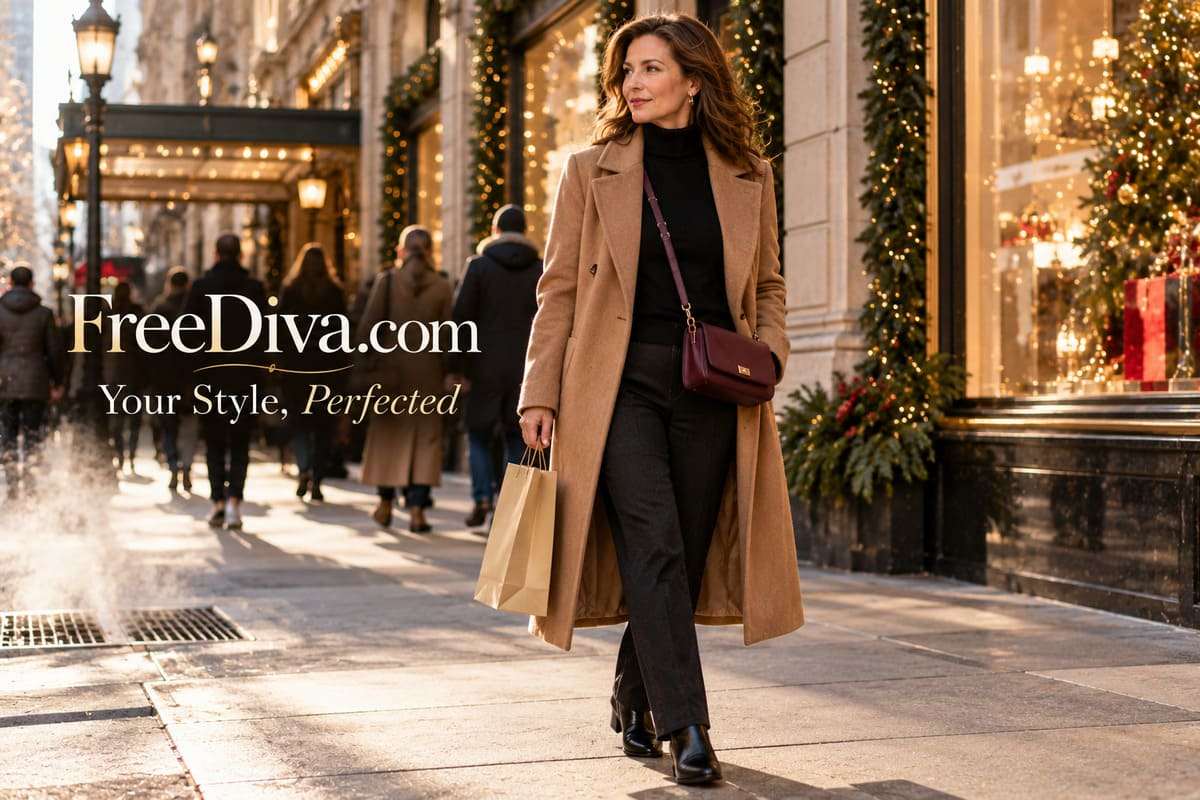
So when police complained about Black Friday crowds, a good part of what those crowds were coming for was clothing. A winter coat, a party dress, gloves, a hat, a gift sweater: department stores sold the whole holiday wardrobe under one roof, and the day after Thanksgiving was the day families came downtown to look at it. If you have ever read about how the little black dress became a fixture or how the cardigan went from soldiers to everyone, this is the retail world those pieces were sold in.
The stores themselves mostly did not survive. Shoppers moved to the suburbs, branches and malls followed, and by 2006 Strawbridge's had closed and the Wanamaker's flagship had become a Macy's. The day outlived them.
How it went national, then online
Through the 1970s and 1980s the term spread from Philadelphia to other cities, and once retailers embraced the red-to-black story it became the national name for the day. The online chapter is much younger. In 2005, Ellen Davis, working in public relations at Shop.org, the National Retail Federation's digital division, and her team noticed that retailers were reporting a spike in online sales on the Monday after Thanksgiving, when people were back at office computers with fast connections. NRF research confirmed it, they named it Cyber Monday and put out a press release. "It was not a campaign. We had no budget, no committee," she later told Georgetown's McDonough School of Business. In 2026, Cyber Monday is November 30.
So the whole long weekend, from the Thursday night openings to the Monday inbox, rests on two accidents: a grumpy police nickname and a slow news week.
How to shop Black Friday well for clothes
Knowing the history does not get you a better coat, but a few habits do.
- Decide before the day, not in the store. Write down the two or three pieces that would change your winter: the coat you have needed for two seasons, the boots, the good sweater. The guide to what is worth buying in fashion on Black Friday goes category by category, and it is blunt about what is usually a fake deal.
- Shop for the closet you have. A discount on something that goes with nothing is not a saving. If you are working toward a smaller, better wardrobe, the sale is the time to fill a gap, not to start a new direction.
- Buy the investment pieces, skip the trend pieces. Black Friday is good for the things that cost real money at full price: wool coats, leather boots, cashmere. Here is how to check a cashmere sweater before you pay for one, and which winter boots are worth it.
- Read the fabric label every time. The same coat shape can be 80 percent wool or 20 percent. That number decides whether it keeps you warm in January.
- Dress for the fitting room. If you are going in person, wear a smooth fitted top, an easy waistband and shoes you can step out of. The whole outfit is in what to wear Black Friday shopping, written for six hours on your feet.
And Philadelphia's police would want you to know one more thing: go early or go late, because the middle of the day is when the traffic turns black.
If you want a second opinion before you spend, ask the FreeDiva chat stylist whether that coat works with what you already own, or upload a photo to the FreeDiva stylist and it will read your shape and coloring and tell you which pieces are worth hunting for this weekend.
Want Personalized Outfit Recommendations?
Upload a photo and let our AI stylist create complete outfits tailored to your body type, skin tone, and personal style.
Try AI Stylist