A deep winter (also called dark winter) looks best in dark, cool, saturated colors worn against black and pure white: burgundy, deep plum, emerald, true red, deep teal, sapphire, berry and midnight blue, with black, white, charcoal and navy as neutrals and silver, platinum or white gold at the ears. The colors that let her down are the warm, earthy and dusty ones: camel, rust, mustard, beige, khaki, oatmeal, sage and taupe.
That is the whole palette in two sentences. The rest of this guide is about why, and how to turn a list of colors into a closet.
Who is a deep winter?
A deep winter is a woman whose coloring is, above everything else, dark, and secondarily cool. In the twelve-season system the first trait decides the season and the second refines it, which is why The Concept Wardrobe's dark winter guide puts dark first and cool second, and describes the hair as neutral or slightly ashy, with no highlights or sun-lightening.
In practice that usually looks like:
- Hair: medium brown to black, with no gold in it and few natural highlights.
- Eyes: dark brown or black-brown most often, sometimes a deep hazel or a dark, cool blue.
- Skin: anything from very fair to very deep. The undertone reads neutral to cool, and silver jewelry looks cleaner on her than yellow gold.
- Contrast: medium-high to high. The dark hair and eyes stand clearly apart from the skin and the whites of the eyes.
Skin depth does not decide the season. A porcelain-skinned woman with black hair can be a deep winter, and so can a woman with deep brown skin and black-brown eyes. The original 1980 book, Carole Jackson's Color Me Beautiful, was written for an assumed white reader, and a 2020 history of the book in Jezebel points out that later editions split each season into subgroups that serve a wider range of skin tones far better. The twelve seasons are that refinement.
Deep winter has two neighbors. Deep autumn shares the depth but runs warm, so it wears chocolate and olive where you wear black and emerald. Cool winter shares the coolness but is icier and brighter. If you sit on the deep autumn edge, a warm burgundy can still work; on the cool winter edge, a fuchsia might.
The deep winter palette
These are the eight colors FreeDiva shows a deep winter on /style, in the same order, plus how to wear each one.
| Color | Why it works on a deep winter | Wear it as |
|---|---|---|
| Burgundy | Dark and cool-red, echoes the depth of her hair | Sweater, wool skirt, lip |
| Deep plum | Cool and dark without the weight of black | Wrap dress, silk blouse |
| Emerald | Saturated green that a muted face cannot hold | Evening dress, coat |
| True red | Clear, blue-leaning red matches her contrast | Scarf, lipstick, heels |
| Deep teal | A dark cool green-blue, quieter than emerald | Knitwear, a suit |
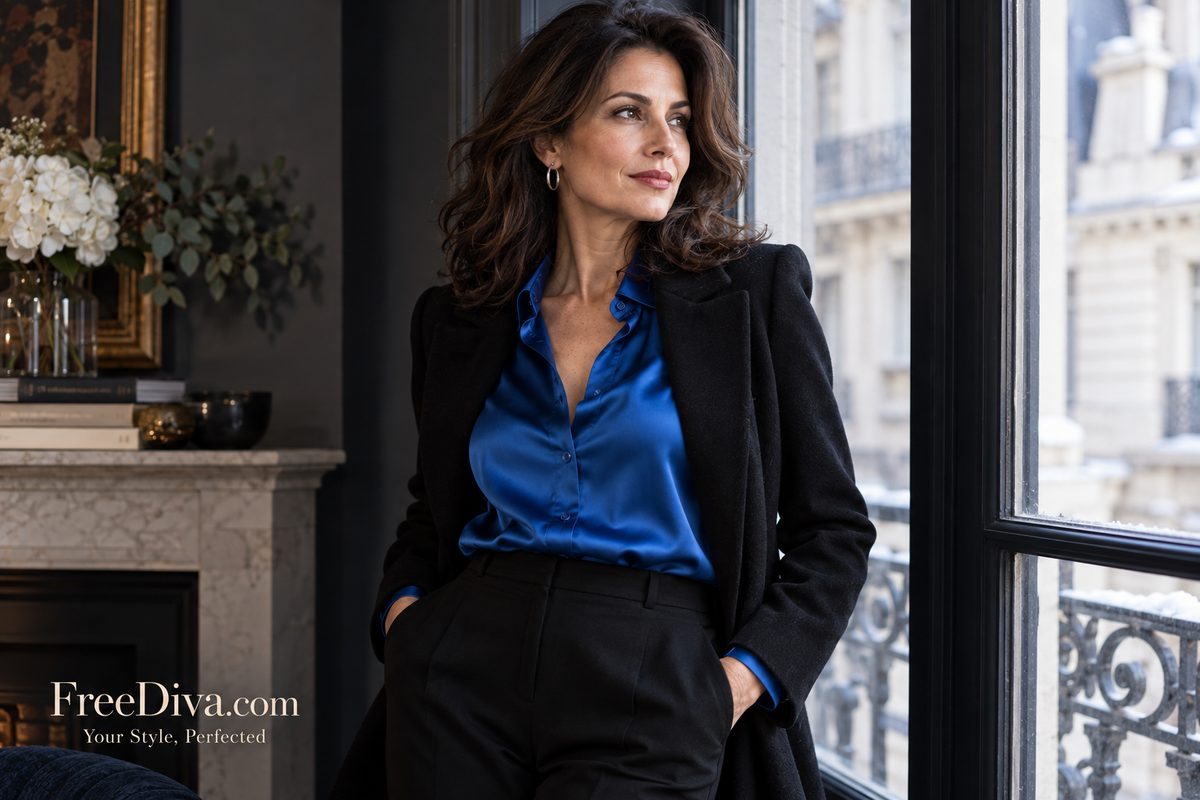
| Sapphire | Strong blue next to dark eyes reads polished | Blouse, cocktail dress |
| Berry | Cool pink-red with depth, softer than true red | Top, lip, cardigan |
| Midnight blue | A night-sky blue that replaces black in daylight | Suit, coat, trousers |
The common thread is depth plus a clean, cool cast. A deep winter can also borrow ruby, aubergine, pine green, icy pink and icy gray as accents, the last two only as small lights against something dark.
Burgundy deserves a note because it was the color of fall 2026 and most stores are full of it. Pick the cool, wine-and-berry versions, not the brick or brown-red ones. Our guide to wearing burgundy has the full how-to.
Can a deep winter wear black?
Yes. A deep winter is one of the few seasons for whom black is a genuine best neutral, not a habit she should break. Her hair and eyes already carry black-brown, so black around the face repeats her own coloring instead of fighting it.
The neutrals on /style are black, pure white, charcoal and navy. Two rules make them work harder:
- Keep some contrast near the face. Head-to-toe black can flatten a deep winter with fair skin into a pale oval floating on a dark shape. A white collar, a sapphire top under a black jacket or a silver earring brings the contrast back.
- Pure white beats ivory. Cream and ecru carry yellow, and on a deep winter they look slightly dingy beside the skin. Optic white looks fresh.
Charcoal and navy are the daytime substitutes when black feels severe for the office or a lunch.
Colors that drain a deep winter
FreeDiva's avoid list for deep winter is orange, rust, mustard, camel, tan, beige, peach, khaki, oatmeal, sage, taupe and anything dusty. They fail for two separate reasons.
Warm and earthy shades (camel, rust, mustard, tan, peach) carry yellow. Next to cool skin they push the face toward sallow, and the effect is strongest right under the chin, which is why a camel turtleneck is a worse idea than camel trousers.
Muted and dusty shades (sage, taupe, oatmeal, khaki) are low in saturation. Placed next to strong dark hair and eyes, a soft color looks weak and the face looks tired by comparison. The French chemist Michel Eugene Chevreul described this effect in 1839: colors placed side by side push each other apart in hue and in lightness (his 1839 book, now on Project Gutenberg). A grayed color beside a high-contrast face does not blend in; it gets read as tired.
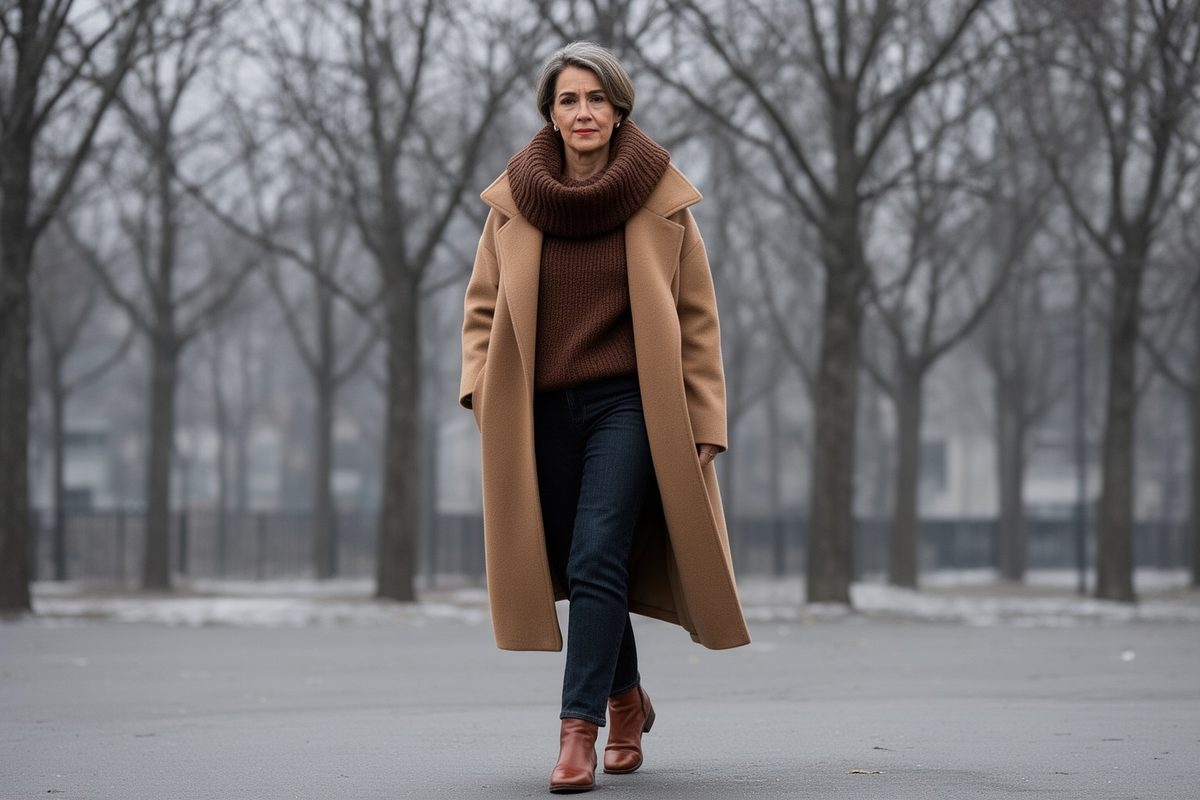
If you love a camel coat, you do not have to give it away. Wear it open over a black sweater and a sapphire scarf, so the color at your face is yours and the camel sits below the shoulder.
Makeup and hair color for a deep winter
Makeup for a deep winter follows the clothes: cool, clear and deep enough to show.
- Lips: blue-based reds, berry, plum and wine. Charlotte Tilbury's red lipstick guide notes that "Blue-based red lip shades are extremely flattering for a cool-toned complexion and can help teeth to appear whiter." On deeper skin, a makeup artist quoted by Makeup.com points to "gorgeous berries and red-browns." For more on finding the shade, see our red lipstick guide.
- Cheeks: rose, berry or a cool plum, never peach or coral.
- Eyes: charcoal, plum, navy and taupe-free browns that lean gray. Black liner and black mascara suit you; on very fair skin, a smudged charcoal liner is softer than a hard black line.
- Base: match the undertone exactly. A foundation one shade too golden is the most common reason a deep winter looks "off" in photos. Our makeup colors guide walks through undertones.
Hair: keep the depth. Ask your colorist for neutral or cool browns, espresso, blue-black and soft black. Golden, caramel and copper highlights are the fastest way to turn a deep winter into a muddy autumn. When gray comes in, a deep winter often looks striking with salt-and-pepper or full silver, because the cool gray agrees with her undertone; blending it with a cool brown is the gentler route.
Metals and jewelry
Silver, platinum and white gold are the deep winter metals on /style. Choose bright, polished finishes over brushed or antiqued ones, which read gray against dark hair. Gunmetal is a good second for evening.
For stones, follow the palette. Sapphire, emerald, ruby, garnet, amethyst and onyx all repeat a deep winter color. The GIA notes that sapphire comes in "every color but red," but for you it is the classic deep blue; emerald is the May birthstone, and the GIA says the first known emerald mines, in Egypt, are believed to have been worked as early as 3500 BC. Pearls work too, in white or the darker gray Tahitian tones, rather than the cream-gold ones.
Five deep winter outfits
These start from pieces most women already own and use the palette above. Adjust the cut to your shape with our body type guide.
1. The burgundy sweater and black trousers
A burgundy merino crewneck, black wide-leg wool trousers, black loafers and silver hoops. It is the easiest deep winter outfit there is: two of your own neutrals and one jewel tone at the face. Swap the loafers for a black ankle boot when it snows.
2. The white shirt and midnight suit
A pure white cotton shirt under a midnight blue trouser suit, platinum or silver studs, black pumps. This is your interview and board-meeting look, and midnight reads softer than black in daylight. It belongs in any capsule wardrobe built around your season.
3. The emerald dress for an evening out
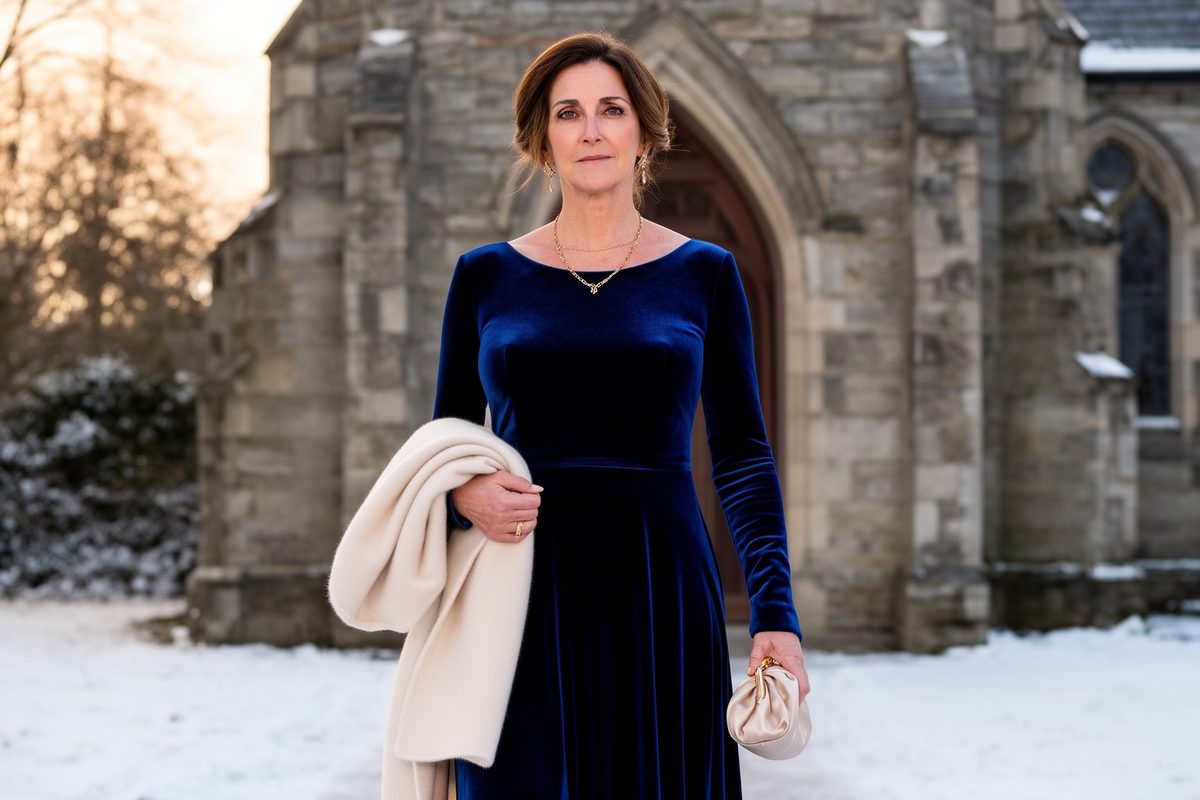
An emerald satin or crepe midi with long sleeves, black pointed heels, white gold drops and a black clutch. Emerald is the color a deep winter can wear that most of the room cannot, which is the point of an evening. For the dress-code side of it, see what cocktail attire means now.
4. The charcoal coat with a true red scarf
A long charcoal wool coat, black jeans, black boots and a true red cashmere scarf wrapped high. The coat is the neutral; the scarf puts the clear red where it does the most good, next to your face. More cold-weather combinations are in our winter outfits guide.
5. The deep teal knit for the weekend
A deep teal cable sweater, dark indigo jeans, white leather sneakers and a navy quilted jacket. Teal is the friendliest of your jewel tones, rich without looking dressed up.
How to check if you are a deep winter
You can test it in ten minutes at home. Stand facing a window in daylight with no makeup, hair pulled back. Hold a black top under your chin, then a camel or tan one. Then a sapphire or emerald, then a dusty sage.
On a deep winter, the black and the jewel tones make the skin look even and the eyes look sharper; the camel and sage make the jaw shadows deeper and the skin a little yellow or gray. If black and camel look equally good, you may be a deep autumn. If icy pink and fuchsia look even better than burgundy, look at cool winter.
Faster still: upload a photo to the FreeDiva stylist. It reads your hair, eyes and skin, names a season, shows you its swatches, and lets you pick a different season if you already know yours. Then it builds three looks from that palette.
Quick answers
What is the difference between deep winter and dark winter?
None. They are two names for the same season: dark, then cool. Some systems say deep, some say dark.
Can a deep winter wear gold jewelry?
A deep, not-too-yellow gold can pass, especially on a woman near the deep autumn edge, but silver, platinum and white gold are the safe choices.
Is navy or black better for a deep winter?
Both are in the palette. Black is the stronger choice for evening and for high contrast; navy and midnight blue are softer for daytime and work.
Want Personalized Outfit Recommendations?
Upload a photo and let our AI stylist create complete outfits tailored to your body type, skin tone, and personal style.
Try AI Stylist