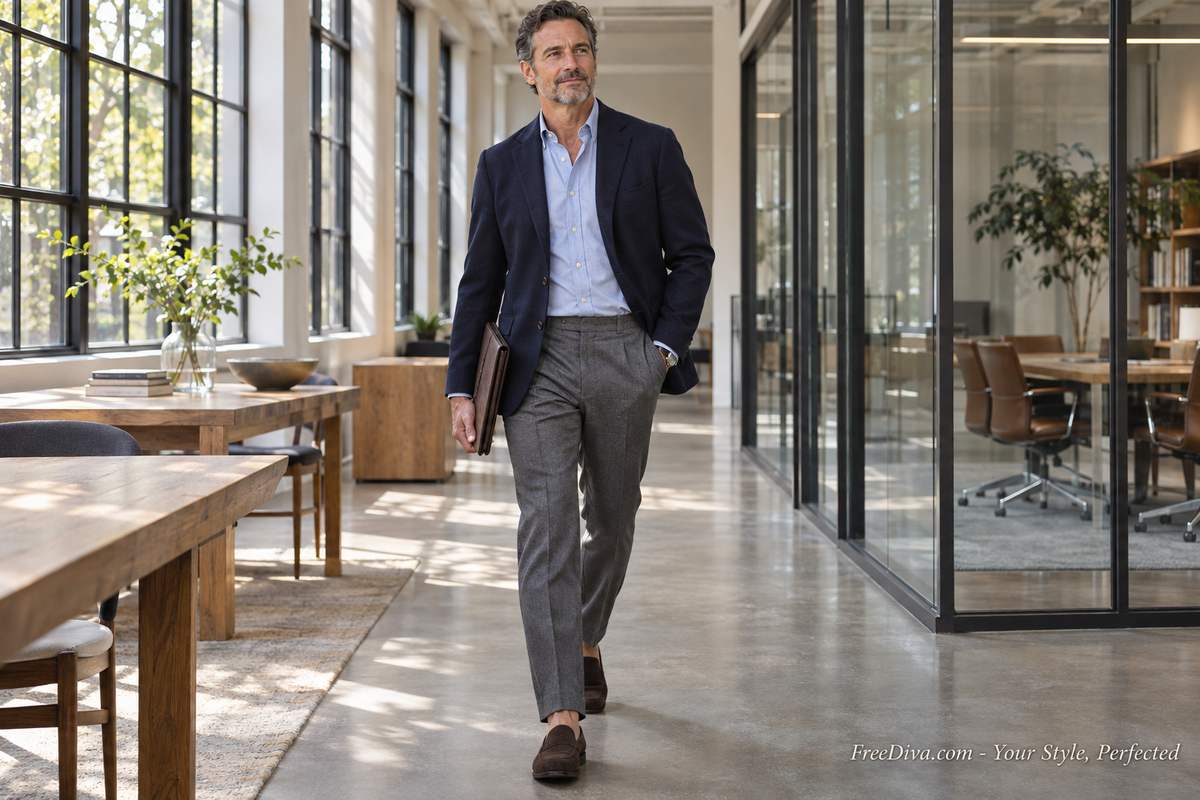
Business casual for men means a collared shirt or a fine knit, tailored trousers or chinos, and leather shoes, with a jacket and tie optional. It sits one step below a suit and one step above weekend clothes. The Emily Post Institute defines it as a seasonal sport coat or blazer with slacks or khakis, a dress shirt, casual button-down, open-collar or polo shirt, tie optional, and loafers or loafer-style shoes with socks, and adds the line that matters most: "Always check and abide by your company's dress code."
What it does not mean is the pleated khakis and tucked polo that got it a bad name. The code is older and more deliberate than it looks, and done well it is the most useful wardrobe a working man can own.
Where business casual came from
The term was pushed into American offices by a clothing company. In 1992 Levi Strauss, selling its Dockers trousers, created a "Guide To Casual Business Wear" and, by the company's own account, mailed it to about 25,000 HR managers. The pamphlet "stressed the idea that casual was not another word for sloppy." The same company history cites a 1995 Evans Research survey in which nine out of ten companies allowed staff to dress casually, up from about two-thirds in 1992. It is a brand telling its own success story, so read the numbers that way, but the timing matches what anyone working through the 1990s saw.
Thirty years on, the pamphlet's point still holds. Business casual is a dress code, not the absence of one.
The pieces, ranked from dressiest to most relaxed
Business casual is easiest to understand as a sliding scale. Every item has a dressier and a more relaxed version, and you can move up or down depending on the day.
| Piece | Dressier end | Relaxed end | Avoid |
|---|---|---|---|
| Jacket | Navy blazer, wool | Unstructured cotton or knit blazer | Suit jacket worn as a blazer |
| Trousers | Gray wool trousers | Chinos in khaki, navy, olive | Cargo pants, joggers |
| Shirt | White or blue dress shirt | Oxford button-down, knit polo | Graphic or slogan tees |
| Knitwear | Fine merino crewneck or V-neck | Quarter-zip, cardigan | Hoodies |
| Shoes | Oxfords, derbies | Loafers, suede chukkas, clean leather sneakers | Running shoes, sandals |
Trousers: wool or cotton, cut clean
Mid-gray wool trousers go with every jacket and every shirt you own, and they are the single most useful business casual item. Chinos come next: khaki, navy, olive, stone. They should have a clean front, a straight or gently tapered leg, and a hem with little or no break. Jeans are where companies differ most. Where they are allowed, dark indigo, no fading, no rips, worn with leather shoes and a collared shirt, so the jeans are the only casual note in the outfit.
The rise matters more as a man gets older. A trouser that sits at or near the natural waist keeps a shirt tucked through a long day; our guide to men's body types and how to dress them explains why a mid-to-high rise suits a fuller middle.
Shirts: the oxford button-down does most of the work
The oxford cloth button-down is the backbone of business casual: sturdy enough to wear without a jacket, crisp enough to wear with one. The collar came from sport. Brooks Brothers borrowed it from English polo players, whose collars were buttoned down to stop them flapping; accounts date it to 1896 or 1900, and Put This On puts the first ready-made Brooks Brothers version at 1900. That pedigree is why the collar looks right without a tie.
Own white and light blue first, then a fine stripe or a pale pink. Spread-collar dress shirts are the dressier end. A knit polo with a proper collar, in a fine cotton or merino, is the relaxed end, and looks far better under a blazer than a pique tennis polo.
Knitwear: the jacket substitute
A fine-gauge merino crewneck or V-neck over a collared shirt is the outfit that has replaced the jacket in many offices. Navy, charcoal, camel and forest green cover most needs. Keep the knit thin enough that the shirt collar sits flat under it. A cardigan or quarter-zip is fine on the relaxed end; a heavy cable knit belongs to the weekend. If you are buying one good sweater, our guide to buying a cashmere sweater that lasts is written for women, but the advice on yarn, gauge and seams is the same for men.
Jackets: unstructured is the modern default
The business casual jacket is a blazer or sport coat, not the top half of a suit. A suit jacket worn with other trousers almost always looks like what it is, because its smooth worsted cloth asks for matching trousers. Choose a cloth with texture instead: hopsack, flannel, tweed, cotton, linen in summer.
An unstructured jacket, with little or no padding in the shoulder and a light lining or none, is the most useful version. It sits like a cardigan and reads like a jacket. A navy one goes with gray trousers, khakis and dark jeans, which is most of the office.
Shoes: leather, polished, in brown
Brown shoes are the natural business casual color. Suede or leather loafers, derbies, chukka boots, and for most offices, plain leather sneakers in white or brown with no logos. Black oxfords are not wrong but lean formal. The belt matches the shoes in color and roughly in finish.
Office day or client meeting: two versions of the same code
Business casual inside your own company and business casual with a client are not the same. The first is about comfort and consistency; the second is about respect for the person across the table.
The everyday office version
A good office day: gray merino crewneck over a white oxford, stone or navy chinos, brown leather derbies or suede loafers. Or a knit polo with wool trousers and loafers. No jacket needed unless the building runs cold. Watch the people two levels above you; whatever they wear on an ordinary Tuesday is the ceiling and the floor of your office's code. Swap colors and textures through the week rather than buying more pieces: two pairs of trousers, five shirts and three knits make more combinations than most men use.
The client meeting version
For a client meeting, move every piece one step up. The navy blazer goes on. The shirt becomes a white or blue dress shirt, freshly pressed. Wool trousers instead of chinos. Polished leather shoes, not suede and not sneakers. Carry a tie in your bag if you do not know the client's culture; you can put it on in the lobby, and you cannot conjure one in the meeting room.
Dress to the client, not to your own office. A tech startup meeting a bank should step up; a bank visiting a design studio can drop the tie. When in doubt, the jacket is the variable: wear it in and take it off if everyone else is in shirtsleeves.
The same logic runs through high-stakes meals, which we cover in what to wear to a business dinner, and interviews, in the modern job interview wardrobe.
Is business casual the same as smart casual?
Not quite. Business casual is a work code: collared shirts, trousers, leather shoes. Smart casual is a social code, used for dinners, parties and some events, and it allows more: dark jeans, a fine T-shirt under a blazer, suede boots, a little more color. Our explainer on smart casual covers the code from a woman's side, but the line between the two is the same for men. If an invitation to a work event says "smart casual," dress at the business casual level and you will be right.
What dates a business casual wardrobe
A few things mark a man as having stopped updating, and they are easy fixes:
- Pleated, wide khakis in a light tan. The Dockers era's uniform. A flat-front or single-pleat trouser in a richer color looks current without trying.
- Shirts with too much fabric at the waist, billowing when tucked. A slim or tailored fit, or a tailor taking in the sides, solves it.
- Square-toed shoes and thick rubber soles. A rounded toe and a leather or slim rubber sole look sharper.
- A logo on everything. Business casual looks best plain.
- Short-sleeved dress shirts under a jacket. Wear long sleeves and roll them if it is hot.
Quick answers
Can a man wear jeans for business casual?
It depends on the company. Where jeans are allowed, wear dark indigo with no fading or rips, a collared shirt and leather shoes. Never wear jeans to a client meeting unless the client is wearing them.
Do you need a tie for business casual?
No. A tie is optional in business casual, and most men skip it. Keep one at the office for unexpected meetings.
Are polo shirts business casual?
Yes, in most offices. A knit polo in fine cotton or merino, worn with chinos or wool trousers, looks more polished than a sporty pique polo.
Are sneakers business casual?
In many offices, yes, if they are plain leather, clean and in white, brown or black. Running shoes and colorful athletic sneakers are not.
FreeDiva's stylist has a Men's looks button: pick Men's, choose a work occasion, and it builds three looks for your shape from one photo. Try it with your own photo before your next Monday.
Want Personalized Outfit Recommendations?
Upload a photo and let our AI stylist create complete outfits tailored to your body type, skin tone, and personal style.
Try AI Stylist