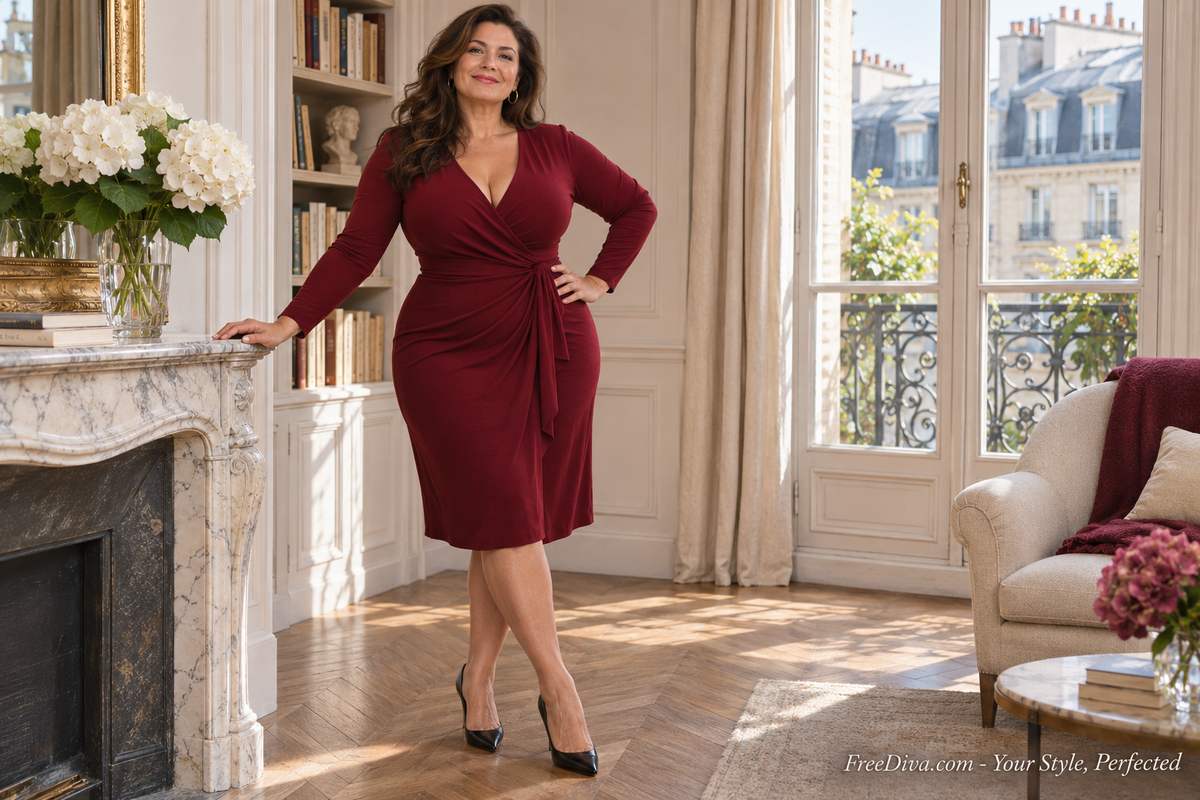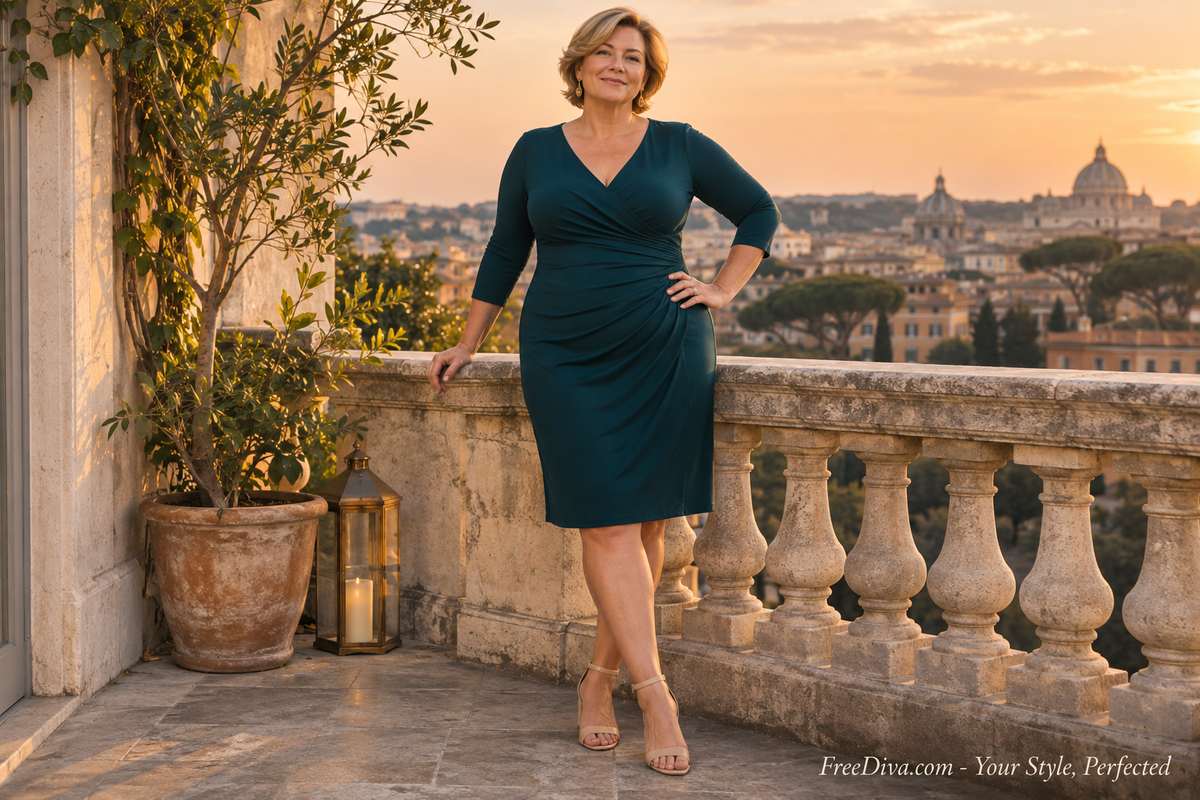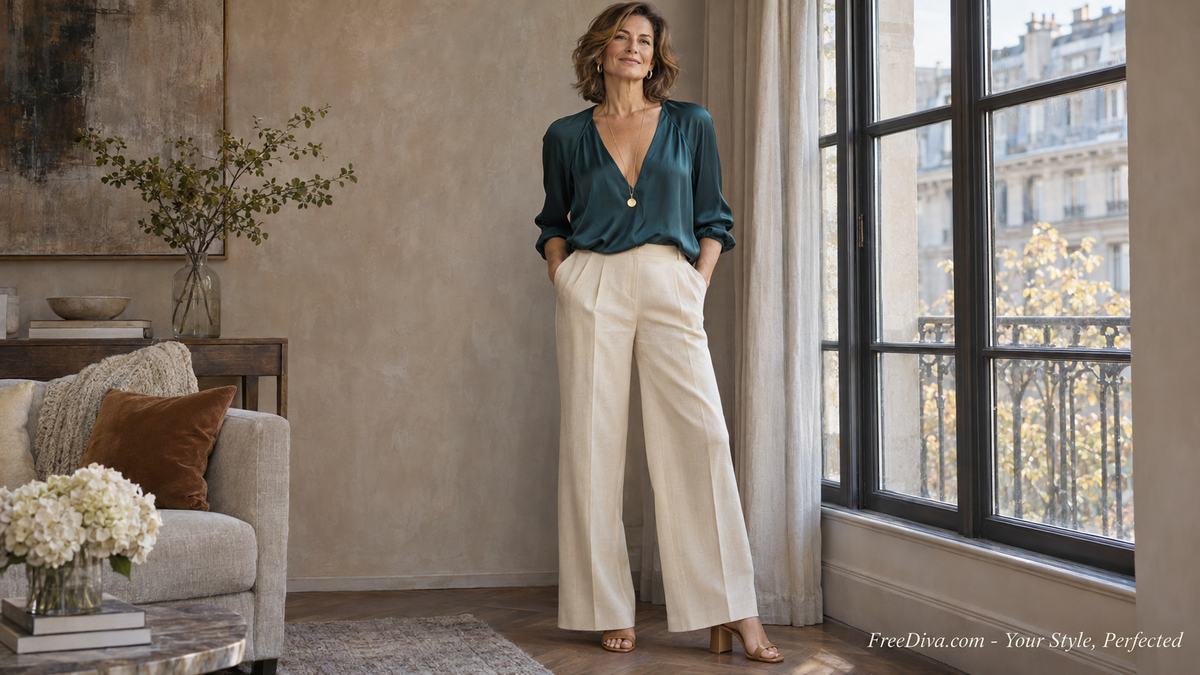
The best tops for an inverted triangle shape have an open, vertical neckline (V, scoop, wrap or a deep cowl), plain shoulders with no pads, epaulets or puffs, and either raglan or dolman sleeves or a set-in seam that sits exactly at the shoulder bone. Soft, drapey fabrics like silk, viscose, jersey and fine merino work better than stiff cotton poplin. Then the work moves below the waist: a fuller skirt, a wide or flared leg, or a lighter color on the bottom half to balance the width up top.
An inverted triangle, in FreeDiva's terms, is a woman whose shoulders or bust are wider than her hips. On the tape, the bust measures at least 5% more than the hips. If you are not sure which you are, our guide to measuring your body shape takes five minutes. Most guides only talk about swimmer's shoulders. But the same shape covers a full bust over slim hips with ordinary shoulders, and that woman needs some of the same tops and some different ones. Where the advice splits, I say so below.
This guide goes from the neck down, because that is the order in which a top either works or does not.
The neckline: open and vertical
The neckline is the single most important choice for an inverted triangle, because it decides whether the eye travels across the shoulders or down the body. An open, vertical neckline breaks up the expanse between shoulder points and draws a line toward the waist.
Stitch Fix's stylists recommend V-necks and scoop necklines "that elongate the look of your torso" for this shape. Angie Cox, the stylist behind You Look Fab, goes further in her guide to the inverted triangle: "Tops with low and/or open necklines are your friend, especially when you have a larger bust and shorter neck."
| Neckline | For an inverted triangle | Notes |
|---|---|---|
| V-neck | Best | Deeper is better; 3 to 4 inches below the collarbone is a good start |
| Scoop or U | Very good | Choose a narrow, deep scoop over a wide, shallow one |
| Wrap or surplice | Very good | Also the best choice for a full bust |
| Cowl | Good | Soft drape adds interest without width |
| Open shirt collar | Good | Undo two buttons, roll the sleeves |
| Crew | Fine | In a soft knit, with a long necklace |
| Boat or bateau | Skip | Runs straight across, the widest line possible |
| Off-shoulder, square, straight strapless | Skip | Frames the shoulder line |
The two to watch are the boat neck and the square neck. Both are cut to frame the collarbone and shoulders, which is why they are recommended to pear shapes, and why they turn broad shoulders into the headline.
A turtleneck is the interesting one. A broad-shouldered woman with a long neck can wear a slim, fine-gauge turtleneck very well if she adds length elsewhere, a long pendant or an open blazer. A full-busted inverted triangle should mostly skip it: it creates one solid block from chin to bust.
The shoulder: plain, and fitted at the bone
Anything that sits on or extends the shoulder adds width to the widest part of you. That includes shoulder pads, epaulets, puff and leg-of-mutton sleeves, ruffles, flutter caps and shoulder ruching. Cox's list of things to avoid is precise: "shoulder details that visually accentuate width, like epaulettes, puffy sleeves, shoulder ruching, flutter sleeves."
If you dressed through the 1980s, you remember the other extreme. FIT's Fashion History Timeline sums up the decade's power dressing as "padded shoulders and bold accessories." That look was built to give every woman an inverted triangle. On a body that already has one, a padded shoulder is too much of a good thing.
Fit matters as much as decoration. On a set-in sleeve, the shoulder seam should land at the edge of your shoulder bone, where the shoulder turns down into the arm. Broad-shouldered women often buy a size up to fit the shoulders, and then the top is too big everywhere else, which makes the torso look boxy. Two better solutions:
- Buy for the shoulders and have the body taken in. Taking in side seams on a blouse or knit is a simple job for an alterations shop. Changing a shoulder is not.
- Choose tops without a shoulder seam to fit. Which brings us to sleeves.
The sleeve: where the seam goes changes everything
The raglan sleeve is the inverted triangle's best friend. Instead of a seam around the top of the shoulder, a raglan sleeve is sewn in a diagonal line from the neckline to the underarm, so there is no horizontal seam marking how wide your shoulders are. Cox puts it nicely: "Raglan sleeves have a magical way of narrowing wider shoulders, and widening narrow shoulders."
The sleeve is named for FitzRoy Somerset, 1st Baron Raglan, who lost his right arm at Waterloo in 1815 and later commanded British troops in the Crimea. The usual story says it was cut for him so he could dress more easily. Word historian Dave Wilton at Wordorigins.org notes that the earliest clothing use he has found is a London tailor's advertisement for "the Raglan Cape" dated 19 March 1854, so treat the details of the origin story with some caution.
Look for raglan sleeves on sweatshirts, baseball tees, many knit sweaters and some blouses. Other sleeves, ranked:
- Dolman and batwing. Cut in one piece with the body, deep armholes, no shoulder seam. Cox's advice is to pair them with "waist definition and an open neckline," otherwise the shape turns into a box.
- Kimono and drop shoulder. The seam falls below the shoulder point, which softens the line. A slight drop is good; a seam halfway down the bicep looks oversized.
- Set-in, fitted at the bone. Classic and fine, if the fit is right.
- Sleeveless with wide straps. Choose straps cut in toward the neck, not out at the shoulder edge. Halter necks work on the same principle and are worth trying.
- Cap sleeves. Skip. They end on the widest point and draw a horizontal line there.
Volume belongs lower on the arm if it belongs anywhere. A bishop sleeve or a flared cuff puts the interest at your hips' level, which helps.
Fabric and detail: soft above, structure below
Fabric is the least-discussed part of the advice for inverted triangles. A crisp cotton poplin stands away from the body and holds the width of the shoulders out to the hips. A fabric with drape falls from the shoulder and hugs the body below it. "Tops made of soft knits and wovens are best because their superior drape de-emphasizes the shoulder line," Cox writes.
Good choices: silk and silk crepe, viscose and rayon challis, matte jersey, Tencel, fine-gauge merino and cashmere. Our cashmere buying guide explains how to tell a good one in a store. Heavy cable knits, stiff denim shirts and boiled wool are harder.
Color and pattern follow the same logic. Darker, plainer colors on top and lighter or printed pieces on the bottom shift the visual weight down. Horizontal stripes on a top, especially wide Breton stripes across the chest, add width. If you love stripes, wear them on a skirt, or choose a top with vertical or diagonal pattern.
Length and the bottom half
A top for an inverted triangle should end where it helps the bottom half look fuller. Three lengths work:
- Tucked or half-tucked, into a high-rise bottom with some volume: a full skirt, a pleated midi, a wide-leg trouser. This shows your waist, often well defined on this shape, and lets the bottom half carry width.
- At the high hip, with a slight peplum or flared hem. A peplum adds the curve below the waist that narrow hips lack.
- Long, to the low hip, over slim pants, if you want a column. Fine, but the bottom half then needs a lighter color.
What to skip: tops that stop at the bust (cropped boxy tees on a full bust), and tops that cling all the way down over narrow hips, which make the shoulders look widest by comparison.
Below the waist, the advice is the same everywhere because it works. Stitch Fix suggests "A-line skirts, wide-leg trousers and flared denim that add volume below." Cox notes that narrow hips and slim legs give "tremendous choice when it comes to pants," but that straight legs usually beat true skinnies, which make the base look too small. Our older post on balancing broad shoulders has full outfits built on this.
If your inverted triangle is mostly bust
Some inverted triangles have ordinary shoulders and a full bust over slim hips. Most of this guide applies, with three changes:
- Wrap and surplice tops come first, not V-necks in general, because they follow the curve of the bust instead of stretching across it.
- Fit the bust, then tailor the waist. Buttoned shirts gape on a full bust; a shirt with princess seams or bust darts, or a knit, avoids it.
- Skip high necklines and front pockets or ruffles on the chest. They add volume exactly where you already have it.
Quick answers
What tops should you avoid with broad shoulders?
Boat necks, square and off-shoulder necklines, cap and puff sleeves, shoulder pads, epaulets, and wide horizontal stripes across the chest. All of them draw a line across the widest part of you.
Can an inverted triangle wear a turtleneck?
Yes, in a fine, soft knit, if your neck is long and your bust is not full. Add a long necklace or an open jacket to break the block.
Are halter tops good for broad shoulders?
Usually yes. A halter cuts in toward the neck, so the shoulders are framed from the inside, not across the top. It shows the arms and back, often the best parts of this shape.
For the full picture across every garment, start with our complete body-type guide, and remember that most body-type rules are guidelines, not laws. If you want to see the advice applied to you, upload a photo to the FreeDiva stylist, or give it your bust, waist and hip measurements, and it will build three looks around your shape.
Want Personalized Outfit Recommendations?
Upload a photo and let our AI stylist create complete outfits tailored to your body type, skin tone, and personal style.
Try AI Stylist