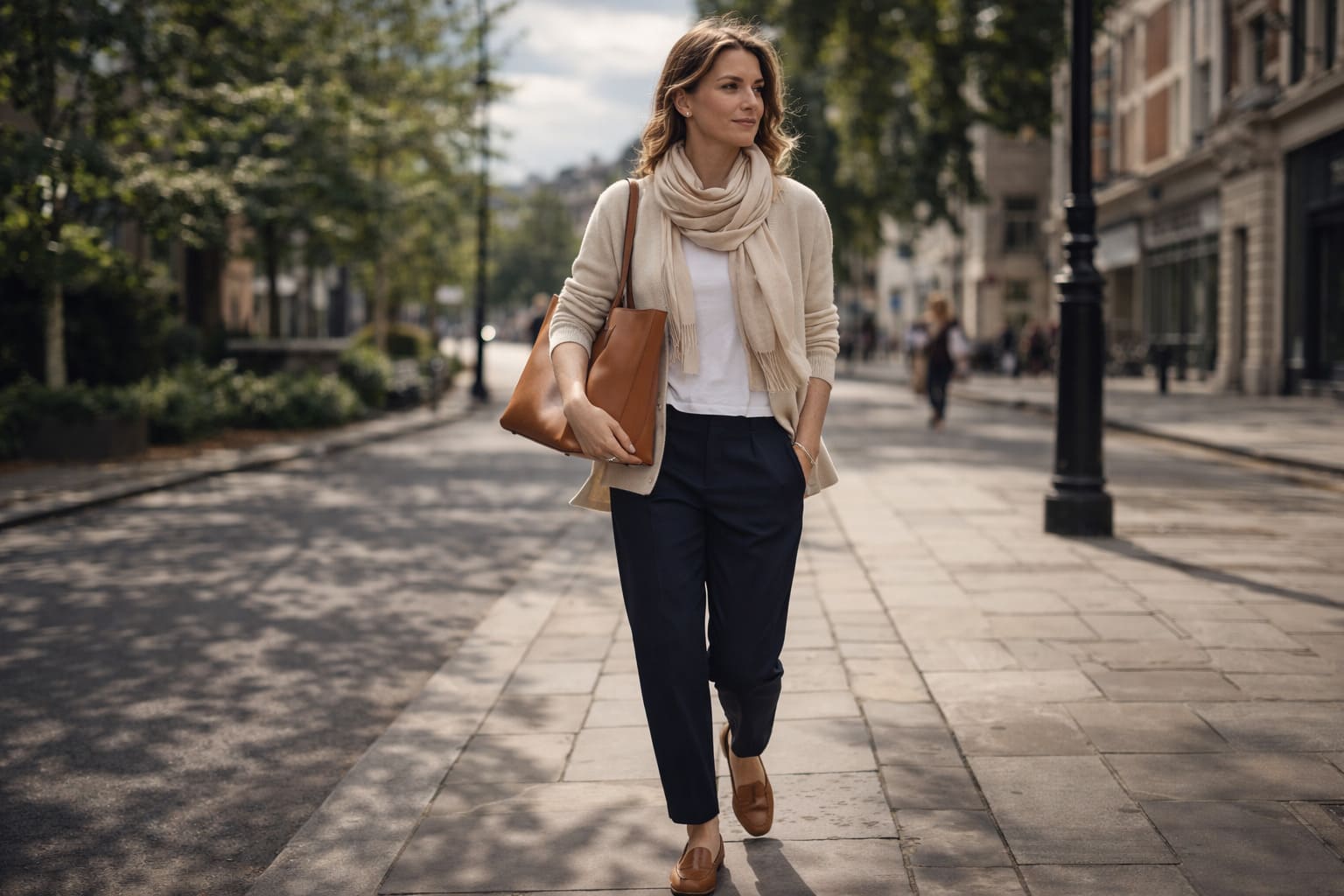
Light Layers: The Secret to Looking Put-Together in Unpredictable Weather
There are exactly four weeks per year when the weather is predictable. The rest of the time, you're gambling every morning with your outfit — and most mornings, you lose.
Too many layers and you're peeling off a sweater by 11 AM, shoving it into a bag that's already too full. Too few and you're shivering through an outdoor lunch, pretending you're fine while mentally cursing yourself for not bringing a jacket.
Light layering solves this. Not heavy fall-and-winter layering with wool coats and chunky knits, but light layering — the art of adding and removing thin, versatile pieces throughout the day so you're always comfortable and always look like you planned it.
The Philosophy of Light Layering
Heavy layering is about warmth. Light layering is about adaptability. You're not trying to survive a blizzard — you're trying to navigate a day that might start at 52 degrees, warm to 68, and drop back to 55 by evening.
The principles are simple:
1. Every piece must look good alone. If you take off a layer, the outfit underneath should be complete. No ratty tees hiding under cardigans. No shapeless tanks only made acceptable by what's on top.
2. Layers should be thin and packable. If you can't fold it into your bag when you take it off, it's too heavy for light layering.
3. Each layer adds visual interest, not just warmth. A light layer should contribute texture, color, or structure to the outfit — not just be a thermal afterthought.
The Light Layering Toolkit
Cardigans (Your Most Versatile Layer)
The cardigan is the Swiss army knife of light layering. Open, buttoned, tied over shoulders, belted — it's endlessly adaptable and works in virtually every setting.
The fine-gauge cotton or cotton-cashmere cardigan: Your everyday workhorse. Thin enough to fold into a bag, substantial enough to actually provide warmth. In black, navy, or cream, it goes over everything.
The longer, duster-style cardigan: A cardigan that hits at the thigh or knee creates a long line that's flattering and architectural. Layer it over a fitted top and slim pants for an elongated silhouette.
The cropped cardigan: Hits at the natural waist and works beautifully with high-waisted pants and skirts. It's more youthful and modern than a longer style without being trendy.
Where to shop: Vince makes exceptional lightweight cardigans. COS has interesting, modern cuts. For budget options, Uniqlo's merino and cotton cardigans are hard to beat for the price.
Vests (The Underrated Hero)
A vest adds warmth where you need it most (your core) without overheating your arms or restricting movement. And because it's sleeveless, it layers beautifully without adding bulk to your silhouette.
The tailored vest: Worn over a button-down or turtleneck, a tailored vest (think menswear-inspired) is razor-sharp. It creates a V-shape at the neckline that's flattering and professional.
The knit vest: Softer than tailored, a fine-knit vest in merino or cashmere over a long-sleeve tee or blouse is quietly stylish. It's the kind of piece that makes people think you're "good at dressing" without being able to pinpoint why.
The quilted vest: For outdoor activities and casual weekends, a lightweight quilted vest (not a puffer vest — thinner than that) provides insulation and wind protection. In navy, olive, or cream, it's practical and polished.
Light Jackets
The cotton or linen blazer: We've covered this elsewhere, but it bears repeating — an unlined blazer in a natural fiber is the ideal light layer for spring and early fall. Professional enough for work, relaxed enough for weekends.
The shirt jacket: A flannel, cotton twill, or lightweight wool overshirt that wears like a jacket. Perfect for days in the 50-65 range. Wear it buttoned like a jacket or open like a cardigan.
The bomber or utility jacket: In a lightweight cotton or nylon, a bomber or utility jacket adds casual edge. Look for one with a trim fit that doesn't overwhelm your frame.
Sézane makes beautiful light jackets with French-girl detail. Everlane and Madewell are reliable for casual options. Theory does light blazers that feel like wearing a cardigan.
Scarves and Wraps
A lightweight scarf is the lightest "layer" you can carry. It takes up almost no space in your bag, adds warmth when you need it, and contributes color or pattern to your outfit.
Silk scarves: Tied at the neck, around your hair, or on your bag. Not as warm as wool, but they add polish and a small amount of protection from cool breezes.
Cotton or modal scarves: Lighter than wool, warmer than silk. The ideal transitional scarf.
Cashmere wraps: A thin cashmere travel wrap works as a scarf, a shawl, an airplane blanket, and an emergency layer. Worth every penny.
Light Layering Formulas for Every Scenario
The Office (Where AC Is Arctic)
Cotton tee + fine-gauge cardigan + cotton blazer
Three layers, all lightweight, all removable. Start the commute with the blazer on. At your desk, lose the blazer and keep the cardigan. In the conference room where the AC is set to "meat locker," put the blazer back on.
Button-down shirt + knit vest
The vest adds a layer of insulation to your core without making you look like you're wearing a coat indoors. This combination is sharp and professional.
The Weekend
Long-sleeve tee + denim jacket
The denim jacket is possibly the most versatile light layer in existence. It goes with dresses, skirts, jeans (Canadian tuxedo!), trousers, and shorts. It works in morning chill and evening cool.
Tank or tee + open flannel shirt
The flannel adds pattern, warmth, and that "I'm casually stylish" vibe. When it gets warm, tie it around your waist.
The Evening Out
Silk cami + lightweight blazer
The blazer protects against evening chill and air-conditioned restaurants. The silk cami underneath is dressy enough for dinner and warm-weather cocktails.
Dress + cashmere wrap
Throw a cashmere wrap over your shoulders for the walk to the restaurant; drape it over your chair when you sit down. Elegant, easy, effective.
Travel
Fitted long-sleeve tee + zip-up knit hoodie + lightweight packable jacket
Three layers that fold small and cover a wide temperature range. The knit hoodie (not a fleece hoodie — a fine-gauge cotton or merino zip-up) is the key piece here. It's polished enough to wear through airports and into restaurants.
The Art of Taking Off a Layer Gracefully
This sounds silly, but it matters. When you remove a light layer, what you do with it affects how put-together you look.
Drape, don't ball. Fold your cardigan or blazer and drape it over your bag or the back of your chair. Never wad it up and stuff it somewhere.
The shoulder drape. Tying a sweater or cardigan over your shoulders is a styling move, not just a storage solution. It adds a layer of visual interest to a simple outfit while keeping the layer accessible.
The bag test. Before you leave the house, ask: can this layer fold flat and fit in my bag? If not, consider a lighter option. There's nothing chic about clutching a balled-up jacket all afternoon because you have nowhere to put it.
Color Strategies for Light Layers
The Neutral Layer Over Color
When your base outfit has color or print, layer with neutrals: a cream cardigan over a printed dress, a navy blazer over a colorful top, a camel vest over everything.
The Color Layer Over Neutrals
When your base outfit is neutral (black pants, white tee), use your layer to introduce color: a sage cardigan, a dusty rose blazer, an olive utility jacket.
Tone-on-Tone
Layer in the same color family for a sophisticated, monochromatic look: a light grey tee under a charcoal cardigan, or a pale blue shirt under a navy vest. This reads as intentional and polished.
Building Your Light Layer Collection
You don't need every piece listed here. You need three to four light layers that work with most of your wardrobe:
- One cardigan in a neutral that matches your most-worn colors
- One light jacket (blazer, denim, or shirt jacket) for more structured days
- One vest for core warmth without arm bulk
- One scarf or wrap for the lightest layer of protection
With these four pieces and the outfits you already own, you can handle almost any temperature between 45 and 75 degrees.
Layering for Your Body
Light layers interact with your body differently depending on your proportions. A few tailored tips:
If you carry weight in your midsection: Open-front layers (unbuttoned cardigans, open blazers) that create vertical lines down your torso are more flattering than closed, buttoned layers that draw the eye to the widest point.
If you're petite: Keep layers cropped or fitted. Long, oversized cardigans can overwhelm a smaller frame. A cropped jacket or a fitted vest maintains your proportions.
If you have broader shoulders: Avoid structured shoulder pads in blazers and jackets. Opt for soft, natural shoulders and V-neckline layering that draws the eye inward and down.
If you're not sure what silhouettes work best on you: FreeDiva's AI stylist can analyze your proportions and suggest specific layering approaches tailored to your body type. It's especially useful for figuring out optimal lengths and fits.
The Bottom Line
Light layering is less about fashion theory and more about practical problem-solving. The weather is unpredictable. Your day has different temperature zones. You need clothes that adapt with you.
The women who always look put-together aren't checking a different weather app than you. They're just better at building outfits with adaptable pieces — layers that come on and off gracefully, look good in every configuration, and fold small enough to carry when they're not needed.
Master light layering and you'll never again be the person sweating in a too-heavy sweater or shivering in a too-thin tee. You'll be the person who looks exactly right in every room and every temperature — and makes it look effortless.
Want Personalized Outfit Recommendations?
Upload a photo and let our AI stylist create complete outfits tailored to your body type, skin tone, and personal style.
Try AI Stylist